That old stump sitting in your yard is doing more than ruining the view. It is a trip hazard, a mower killer, and an open invitation for carpenter ants to move in a few feet from your foundation. Yet when most Twin Cities homeowners start calling around for a price, they run into the same wall: nobody wants to give them a number.
We think that is backwards. Stump grinding is not a mysterious service that requires a sales visit to price. It is measurable work with a formula behind it, and you deserve to know that formula before anyone pulls into your driveway. This guide walks through exactly what stump grinding costs in Minnesota in 2026, what makes one stump cost triple another, and how to tell an honest quote from one you should walk away from.
Key Takeaways
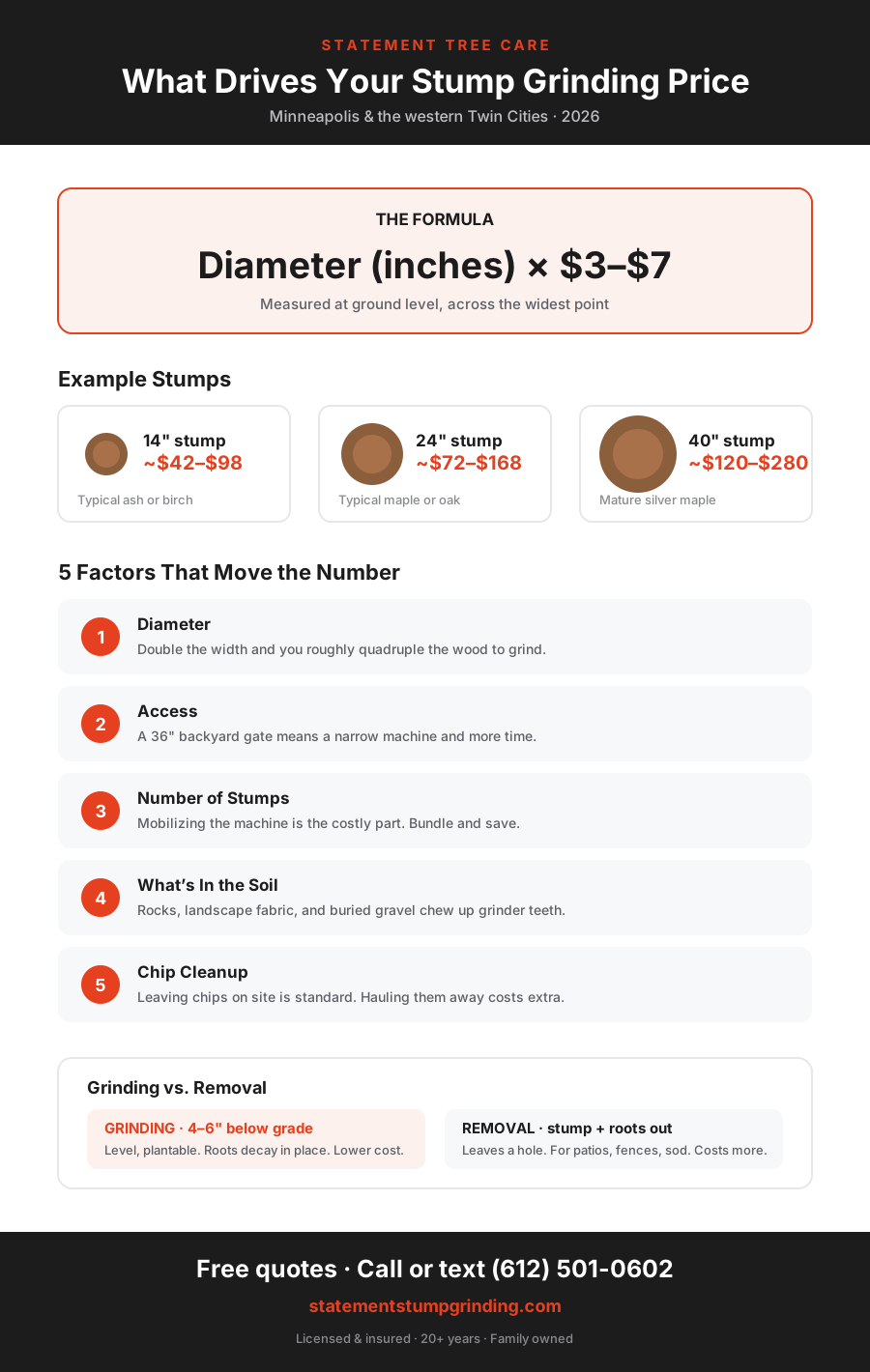
- Most Minnesota stump grinding runs $3–$7 per inch of stump diameter, measured at ground level across the widest point.
- Diameter is the single biggest cost driver. Doubling the width roughly quadruples the volume of wood to grind.
- Grinding and removal are different services at different prices. Grinding takes the stump 4–6 inches below grade; removal pulls the roots out and leaves a hole.
- Multiple stumps almost always lower your per-stump price, because mobilizing the equipment is the expensive part.
- A DIY rental runs $100–$200 per half day but rarely pencils out for large stumps, tight access, or anything near utilities.
- Always ask for a certificate of insurance and a grinding depth in inches. Vague answers on either point are the clearest red flag there is.
Table of Contents
- The Short Answer: $3–$7 Per Inch
- The Five Factors That Move Your Price
- Why So Many Twin Cities Stumps Are Ash
- Stump Grinding vs. Stump Removal
- Should You Just Rent a Grinder?
- Red Flags in a Cheap Quote
- How to Get an Accurate Quote Fast
- Frequently Asked Questions
The Short Answer: $3–$7 Per Inch
Most stump grinding in Minnesota is priced at $3 to $7 per inch of stump diameter. This is the industry-standard approach, and it is how we quote nearly every residential job across Minneapolis and the western suburbs. Where you land in that range depends on access, soil conditions, and how many stumps we are grinding in one visit.
How to Measure Your Stump
Measure across the widest point of the stump at ground level. Not the trunk higher up, and not including the root flare that spreads out at the base. People routinely overestimate by measuring the flare, then get surprised when the quote comes in lower than they feared.
A 24-inch stump at $4 per inch works out to roughly $96. Here is how that scales across the sizes we see most often in the west metro:
| Stump Diameter | Typical Species | Estimated Range |
|---|---|---|
| 12–14 inches | Ash, birch, young maple | $36–$98 |
| 18–24 inches | Maple, oak, elm | $54–$168 |
| 30–36 inches | Mature oak, cottonwood | $90–$252 |
| 40+ inches | Silver maple, old cottonwood | $120–$280+ |
Why There Is a Minimum Charge
Nearly every company, ourselves included, has a minimum for a single small stump. This is not an upsell. The cost of loading a grinder, driving to your property, unloading, and setting up does not change whether your stump is 8 inches or 18. If you have one small stump, the minimum is mostly paying for the trip, which is exactly why bundling stumps is such a good deal.
The Five Factors That Move Your Price
1. Diameter
This is the big one, and the math is less intuitive than people expect. A stump is essentially a cylinder, so when you double the diameter you roughly quadruple the volume of wood that has to be turned into chips. A 40-inch silver maple is not twice the job of a 20-inch ash. It is closer to four times the job, and the price reflects the grinding time.
2. Access
The second question we ask after size is always: can the machine get to it? A front-yard stump with a clear approach is straightforward work. A backyard stump behind a 36-inch gate is a different job entirely, because it means bringing a narrow-access grinder that trades power for the ability to fit. Less power means more passes, and more passes means more time.
Fences, retaining walls, tight side yards, steep grades, and soft or saturated ground all add to the job. None of these are dealbreakers. They just need to be known up front, which is why a photo of the approach helps us quote accurately.
3. Number of Stumps
Multiple stumps on one property almost always drop your per-stump cost, sometimes dramatically. Once the machine is on site and running, each additional stump is far more efficient than the first. If you have three or four stumps scattered around the yard, get them all quoted together rather than doing them one at a time across three seasons.
4. What Is Hiding in the Soil
Rocks, old landscape fabric, buried gravel, chain link remnants, and dirt packed into the root flare are all hard on grinder teeth. Stumps in old landscape beds and stumps near driveways are the usual offenders, because those areas tend to have decades of buried material around them.
This is also why we contact Gopher State One Call before grinding. Utility locates are not optional, and a gas or fiber line running near your stump genuinely changes how the job gets done. Any company that skips this step is gambling with your property.
5. Chip Cleanup
Grinding a stump produces a surprising volume of chips, almost always more than homeowners expect. A 24-inch stump can leave a mound a few feet across. Standard pricing typically includes mounding the chips on site or raking them level into the hole. Hauling them off costs extra, because it means loading, transport, and disposal.
Plenty of our customers keep the chips and use them in beds or on paths. Just know that fresh chips are not the same as finished mulch, and they should not be tilled into soil where you plan to plant right away.
Why So Many Twin Cities Stumps Are Ash
If the stump in your yard used to be an ash tree, you have a lot of company. Emerald ash borer has been moving through Minnesota for years, and the Twin Cities has lost an enormous number of ash trees to it. Cities across the metro have removed boulevard ash at scale, and homeowners have followed on their own properties, often on short notice.
The practical result is a lot of people living with a stump they never planned for, in a spot where they used to have shade. The University of Minnesota Extension maintains current guidance on identification and management if you are still deciding about a standing ash.
If the tree is already down, grinding is usually the fastest route to getting your yard back. It is also worth doing sooner rather than later. Left alone, the stump and its surface roots become a trip hazard, a mower hazard, and a soft, decaying spot in the middle of your lawn.
Stump Grinding vs. Stump Removal
These get used interchangeably in conversation, but they are separate services at meaningfully different prices. Knowing which one you actually need is the easiest way to avoid overpaying.
What Grinding Does
Stump grinding uses a rotating cutting wheel to chew the stump down 4 to 6 inches below grade. The stump disappears from view, the surface is level and ready to plant, and the remaining root system decomposes in place over the next several years. This is what the large majority of homeowners want, and it is the more affordable of the two.
What Removal Does
Stump removal extracts the stump along with the major surface roots, leaving an actual hole that needs backfilling. It costs more, takes longer, and disturbs a much larger area of your yard.
Which One Do You Need?
You need full removal when something is going into that exact spot: a patio, a foundation, a fence post, a retaining wall, or new sod laid directly over it. You need grinding for essentially everything else. If your plan is to throw down grass seed and move on, grinding is what you want, and paying for removal is money you do not need to spend. Our services page breaks down how each one works.
Should You Just Rent a Grinder?
Fair question, and sometimes the answer is yes.
The Real Math
Rental stump grinders run roughly $100–$200 for a half day around the Twin Cities, plus whatever it takes to get the machine to your house. On paper that beats a professional quote for a mid-size stump.
In practice, a few things tend to surprise people. Rental units are usually considerably smaller than professional machines, so a large stump can consume your entire rental window and then some. The machine is heavy and awkward to load, unload, and maneuver, particularly on a slope. It throws debris hard enough that real eye and ear protection are not optional. And if you hit an unmarked utility line or put a rock through your neighbor’s window, that is entirely your problem.
When DIY Actually Makes Sense
One small stump, open front yard, easy trailer access, and a free Saturday? Rent the machine. You will save real money and it is a satisfying afternoon.
Anything large, anything on a grade, anything near a structure or a utility, or anything you cannot easily get a trailer to? The math usually flips, and it flips hard once you factor in a second rental day.
Red Flags in a Cheap Quote
- No proof of insurance. Ask for the certificate, not a verbal assurance. If a grinder throws a rock through a window or a crew member is injured on your property, an uninsured contractor becomes your liability.
- Vague grinding depth. Grinding it down is not a specification. Ask for inches below grade. Anything shallower than about 4 inches will not reliably support grass.
- Undefined cleanup. Settle before the job whether chips are being raked level, mounded, or hauled. This is the single most common source of post-job disappointment.
- No utility locate. If nobody mentions Gopher State One Call, ask why.
- Cash-only, today-only pricing. Urgency is a sales tactic, not a discount.
How to Get an Accurate Quote Fast
You can usually skip the on-site visit entirely. Send us a photo of the stump with something for scale beside it — a shoe, a tape measure, a soda can — plus a rough diameter and a note about how we would reach it. That is genuinely enough for us to give you a real number instead of a wide range.
If you have several stumps, one photo of each and a rough sketch of where they sit saves everyone a step. Most quotes go back out the same day, and most jobs get scheduled within days rather than weeks.
Reclaim Your Yard
We grind every stump 4–6 inches below grade, clean up the chips, and leave a level surface you can plant. Family owned, licensed and insured, and grinding stumps across the west metro for over 20 years.
We serve Minneapolis and the western Twin Cities, including Minnetonka, Eden Prairie, Wayzata, Chanhassen, Chaska, Edina, Excelsior, Orono, and every community in between.
Call or text (612) 501-0602, or request a free quote online.
Frequently Asked Questions
How much does stump grinding cost in Minnesota?
Most stump grinding in Minnesota runs $3 to $7 per inch of stump diameter, measured at ground level across the widest point. A 24-inch stump typically lands around $72 to $168. Access, soil conditions, and the number of stumps determine where in that range you fall, and most companies have a minimum charge for a single small stump.
How deep do you grind a stump?
We grind 4 to 6 inches below grade. That depth matters: it puts enough soil over the remaining root mass that you can seed or sod the spot and expect grass to establish. Shallower grinding leaves wood too close to the surface for reliable turf.
Is stump grinding cheaper than stump removal?
Yes, usually by a wide margin. Grinding takes the stump below grade and leaves the roots to decompose naturally. Removal extracts the stump and major roots, which takes longer, disturbs far more of your yard, and leaves a hole to backfill. Removal is only worth paying for when you are building on that exact spot.
How long does it take to grind a stump?
A typical residential stump takes somewhere between 20 minutes and an hour of actual grinding. Most single-stump jobs are done, cleaned up, and off your property inside of an hour or two. Large stumps, difficult access, and rocky soil push that longer.
Will the tree grow back after grinding?
Not from the stump itself, once it is ground below grade. Some species, especially buckthorn, cottonwood, and certain maples, can send up shoots from surviving surface roots. Those sprouts are easy to control by mowing them or treating them as they appear, and they die out as the root system loses its energy reserves.
Do I need to be home for the appointment?
Usually not. As long as we have clear access to the stump and know exactly which one you want ground, we can complete most jobs without you there. We will confirm the details ahead of time and follow up when it is finished.
What do you do with the wood chips?
Standard practice is to rake the chips back into the hole and mound or level them on site, which most homeowners are happy with. If you want them gone, we can haul them away for an additional charge. Some customers keep them for garden beds and paths, which is a perfectly good use as long as you are not tilling fresh chips into planting soil.
Can you grind a stump near a foundation or sidewalk?
In most cases, yes. It requires more care and sometimes a smaller machine, and we locate utilities first through Gopher State One Call. Stumps very close to a foundation, a septic system, or a utility line need to be assessed individually, so send us a photo showing the stump and what is around it.