You spent a weekend cutting buckthorn out of the back of your lot. Brush hauled, ground visible for the first time in years, and it looked like real progress. Then by mid-summer every one of those cut stumps had thrown up a fistful of new shoots, and the thicket came back denser than what you removed. That is not bad luck and it is not something you did wrong. It is exactly what buckthorn does.
Buckthorn is one of the few plants where cutting it down, by itself, makes the problem worse. If you own a wooded lot anywhere in the west metro you have probably watched this happen. Here is why cut stumps resprout, what your realistic options are for actually killing them, and where stump grinding fits in for the trunk-sized ones.
Key Takeaways
- Cutting buckthorn without dealing with the stump makes it worse. A cut stump usually comes back as several vigorous shoots instead of one stem.
- The regrowth comes from the root crown at the base of the plant, so any method that leaves the crown intact leaves the plant alive.
- Grinding removes the root crown physically — no herbicide, no covering the stump for two years, no return trips to cut resprouts.
- Grinding is the answer for trunk-sized buckthorn, not for a carpet of pencil-thin stems. Those come out faster by hand.
- Killing the stumps does not empty the seed bank. Plan on pulling seedlings for a season or two afterward.
- Late summer through fall is the best window for buckthorn work in Minnesota, and it is also when the plant is easiest to identify.
Table of Contents
- Why Cut Buckthorn Comes Back Thicker
- Making Sure It Is Actually Buckthorn
- Your Options for Killing a Buckthorn Stump
- What Grinding a Buckthorn Stump Involves
- The Stumps Are Only Half the Job
- When to Do This Work in Minnesota
- Frequently Asked Questions
Why Cut Buckthorn Comes Back Thicker
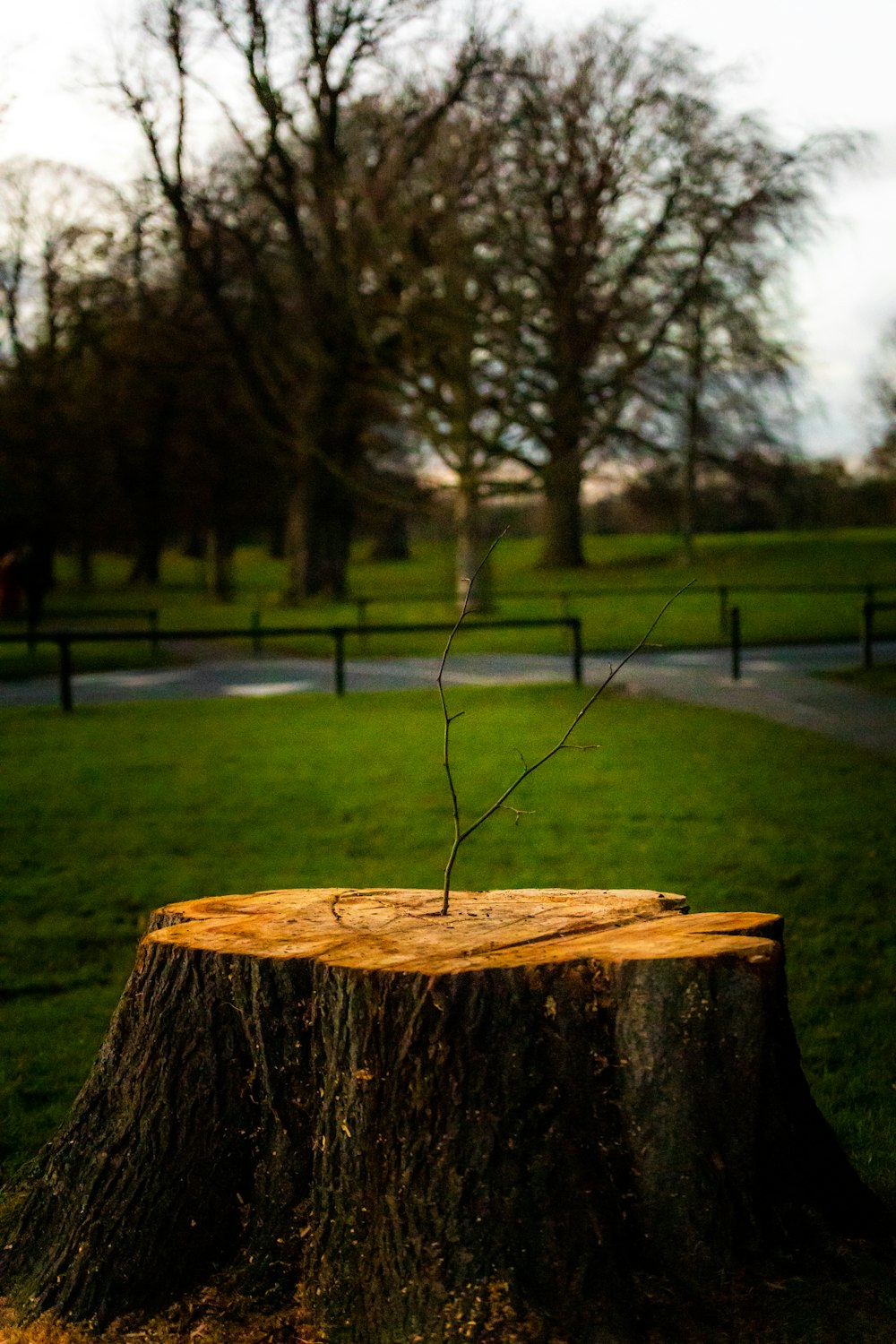
Common buckthorn does not keep its growing points up in the canopy where you can cut them off. It keeps energy and dormant buds down in the root crown, the swollen woody knuckle right at the soil line. Cut the stem and you have not touched that. You have just removed the top growth the plant was feeding, and the crown responds by pushing out every dormant bud it has.
That is why one buckthorn trunk becomes five or six whips the following season. The root system is already established and sized for a much larger plant, so the new shoots grow fast. Homeowners who cut and walk away often end up with a worse thicket in two years than the one they started with, and now the stems are clustered and awkward to get at.
The takeaway is simple: with buckthorn, the cut is not the job. Whatever you do to the stump afterward is the job.
Making Sure It Is Actually Buckthorn
Before anyone takes a saw to a shrub line, make sure you are removing the right plant. Common buckthorn has glossy, egg-shaped, finely toothed leaves with three to five curved veins that arc toward the tip. Twigs often end in a short, stout thorn. Female plants carry clusters of small black berries that ripen in late summer, which is how birds spread it across every wooded lot in the Twin Cities.
The easiest tell is timing. Buckthorn holds green leaves well after the native trees and shrubs around it have dropped theirs, often into November here. Walk your property in late fall and the buckthorn lights up green against bare woods. The Minnesota DNR and University of Minnesota Extension both have good photo guides if you want to confirm before you commit.
Worth knowing: common buckthorn is a Restricted noxious weed in Minnesota. You are not required to remove it from your land, but it is illegal to sell, transport, or plant it. Nobody is going to fine you for the thicket behind your garage — the designation just tells you how seriously the state takes the spread.
Your Options for Killing a Buckthorn Stump
There are four approaches that actually work, plus the one everybody tries first that does not. The right choice depends almost entirely on stem size. Here is how they compare.
| Method | How It Works | Best For | The Catch |
|---|---|---|---|
| Cut only | Removes top growth | Nothing | Resprouts, usually worse |
| Pull with a weed wrench | Lifts crown and roots out | Stems under about 1.5 in. | Hard work, disturbs soil |
| Cut and treat stump | Herbicide kills the crown | Mid-size stems in woods | Timing matters, chemical near lawn or water |
| Cover the stump | Blocks light for two years | Small chemical-free jobs | Slow, ugly, needs checking |
| Grind the stump | Removes crown mechanically | Trunk-sized buckthorn | Needs machine access |
For the pencil-thin stuff, a weed wrench and an afternoon beats everything else. For anything with a real trunk, cut-and-treat and grinding are the two methods that reliably end the plant. Cut-and-treat is cheaper per stem and works well deep in the woods, but it depends on getting herbicide on fresh-cut wood at the right time of year, and plenty of homeowners would rather not spray near a lawn, a garden, or a lakeshore. Grinding does the same job mechanically.
What Grinding a Buckthorn Stump Involves
Grinding a buckthorn stump is the same operation as grinding any other stump, just usually smaller and more of them. The cutting wheel takes the stump and the root crown down to 4 to 6 inches below grade, which is well past the depth where the dormant buds live. Once the crown is chips, there is nothing left to resprout from. No follow-up cutting, no waiting to see whether the treatment took.
Access is the real variable
Buckthorn rarely grows in convenient places. It colonizes fence lines, ravine edges, the strip between your yard and the neighbor’s, and the wooded back third of lakeshore lots. Before grinding, the stems have to be cut and the brush cleared so the machine can physically reach each stump. If a spot is too tight or too steep for the grinder, we will tell you that up front rather than tear up the yard getting there.
Cost on multi-stump jobs
Stump grinding around here generally runs about $3 to $7 per inch of stump diameter, with a minimum for small jobs. Buckthorn stumps are individually small, so the per-stump number is low, but a clump of twenty adds up and the total depends heavily on access, how tight they are clustered, and how much brush has to move first. Multi-stump jobs almost always price better per stump than a single one. There is no way to give you a real number without seeing it — that is what the free quote is for. Our guide to stump grinding costs in Minnesota walks through what drives the price.
The Stumps Are Only Half the Job
Here is the part people do not want to hear. Grinding out the mature buckthorn kills those plants permanently, but it does nothing about the seeds already in your soil. Birds have been eating those black berries and depositing them across your property for years.
The good news is that the seed bank is shorter-lived than the folklore suggests. Research out of the University of Minnesota found that buckthorn seed in Minnesota forest soils germinates almost entirely within the first two years, not the six or more that was long assumed. So you are looking at a couple of seasons of pulling seedlings, not a decade.
Plan for it. Walk the cleared area each spring and fall and pull the little ones while they are still easy to pull — a first-year buckthorn seedling comes out with two fingers. Skip two years of that and you are back to cutting stems. Getting light onto that ground helps too: seed or plant the cleared area so something desirable is competing for the space instead of leaving bare dirt for buckthorn to reclaim.
When to Do This Work in Minnesota
Late summer through fall is the strongest window, for three reasons. The plant is easy to identify once the natives drop their leaves and the buckthorn stays green. Cut-stump herbicide treatments are most effective in late summer and fall, when the plant is pulling resources down toward its roots. And you are working in cool weather with no mosquitoes and clear sightlines through the understory.
Grinding itself is less fussy about season. Ground that is dry and firm makes for easy machine access, and early fall in the Twin Cities is usually ideal. Once the ground freezes hard, grinding gets slower and some jobs are better pushed to spring. If you want the timing details, we covered them in our post on the best time of year for stump grinding in Minnesota.
One thing worth doing right now, in any season: walk the property and count what you actually have. Knowing whether it is eight trunk-sized stems or eighty changes the plan entirely.
Let Us Take the Buckthorn Stumps Off Your List
If you have already cut buckthorn and the stumps are fighting back, or you are planning a clearing project and want the stumps handled properly the first time, we can grind them out for good. Family owned, licensed and insured, and grinding stumps across the west metro for over 20 years. We grind 4 to 6 inches below grade, clean up the chips, and leave you a level surface to replant.
We serve Minneapolis and the western Twin Cities, including Minnetonka, Excelsior, Deephaven, Shorewood, Orono, and every community in between. See what we handle on our services page.
Call or text (612) 501-0602, or request a free quote online.
Frequently Asked Questions
Why does buckthorn grow back after I cut it?
Because the growing points are in the root crown at the base of the plant, not in the stem you removed. Cutting the top off signals the crown to push out its dormant buds, so one trunk typically comes back as several fast-growing shoots. Unless the crown is killed or removed, the plant is still very much alive.
Will stump grinding kill buckthorn for good?
Yes, for the plant you grind. Taking the stump and root crown 4 to 6 inches below grade removes the tissue the resprouts come from, so that individual plant is finished. It does not stop new seedlings from germinating out of seed already in the soil, which is a separate job.
Is grinding better than treating the stump with herbicide?
Neither is universally better. Cut-and-treat is cheaper per stem and practical deep in the woods, but it depends on correct timing and involves chemical near your property. Grinding is mechanical, immediate, and leaves nothing to follow up on, and it makes the most sense for trunk-sized stumps in places a machine can reach.
Can you grind a lot of small buckthorn stumps at once?
Yes, and multi-stump jobs generally price better per stump than a single one. The bigger factors are access and how much brush has to be cleared first so the machine can get to each stump. For a carpet of pencil-thin stems, though, hand-pulling with a weed wrench is usually faster and cheaper than grinding.
How much does buckthorn stump removal cost?
Stump grinding in this area generally runs roughly $3 to $7 per inch of stump diameter, with a minimum for small jobs. Buckthorn stumps are small individually, so cost comes down to how many there are, how clustered they are, and how hard they are to reach. Exact pricing depends on the site, which is why we quote for free.
When is the best time to remove buckthorn in Minnesota?
Late summer through fall. The plant holds green leaves after the natives go bare, which makes it easy to identify, and cut-stump herbicide treatments work best in that window. Grinding is less season-dependent, though dry, firm, unfrozen ground makes access easiest.
How long will buckthorn seedlings keep coming up?
Research from the University of Minnesota found buckthorn seed in Minnesota forest soils germinates almost entirely within the first two years after it drops, rather than persisting for many years as was once believed. Expect to walk the area and pull seedlings for about two seasons after clearing.
Is buckthorn illegal in Minnesota?
Common buckthorn is listed as a Restricted noxious weed, which makes it illegal to sell, transport, or plant in Minnesota. Landowners are not required to remove existing buckthorn from their property, but the designation reflects how aggressively it spreads.