A stump on a Lake Minnetonka lot is rarely just a stump. It is a stump forty feet from the water, behind a retaining wall, at the bottom of a slope, with a paver walk on one side and the neighbor’s arborvitae on the other — and a lawn the owner would very much like to keep intact. The grinding itself might take twenty minutes. Everything around it is the actual job.
We have been grinding stumps around the lake for over 20 years, and the questions lakeshore homeowners ask are consistently different from the ones we get on a flat suburban lot. Here is what actually matters when the stump sits on a lake property: getting the machine to it, knowing what is buried under it, and respecting the shoreland rules that apply near public water.
Key Takeaways
- Access is the real variable on lake lots — not the stump. A tracked, narrow-access grinder fits through most standard gates, but stairs, walls and slopes change the plan.
- Grinding is not excavation, but shoreland rules still apply near the water. Cities around Lake Minnetonka regulate land alteration close to shore, so check before any grading or hauling near the lake.
- Call 811 at least two business days ahead — and remember that private lines like irrigation, invisible fence and dock power are not marked by that call.
- Chips on a sloped lakeside yard need containing so grindings do not wash toward the water in the next hard rain.
- Pricing still runs in the range of $3–$7 per inch of stump diameter, but access and slope are what move a lake job within — or above — that range.
Table of Contents
- Why Lake Properties Are Different
- Getting the Machine to the Stump
- Grinding Near the Shoreline
- What Is Buried Under a Lake Lot
- Slopes, Retaining Walls and Bluffs
- What It Costs on a Lake Property
- Frequently Asked Questions
Why Lake Properties Are Different
Lakeshore lots around Minnetonka were platted long before anyone was thinking about equipment access. A lot of them are deep and narrow, with the house sitting near the middle and the good trees down by the water. The side yards are tight, the grade drops toward the lake, and forty years of landscaping — walls, steps, beds, sprinkler heads, lighting — sits between the driveway and wherever the stump is.
On top of that, the trees themselves tend to be big. Shoreline soil stays moist, and silver maple, cottonwood, willow and boxelder all take advantage of it. When one of those comes down, you are not looking at a 12-inch stump. You are looking at a 36-inch stump with a root flare wider than the machine.
None of this makes the work impossible. It just means a good quote on a lake property comes from someone who walked the lot, not from someone who guessed over the phone.
Getting the Machine to the Stump
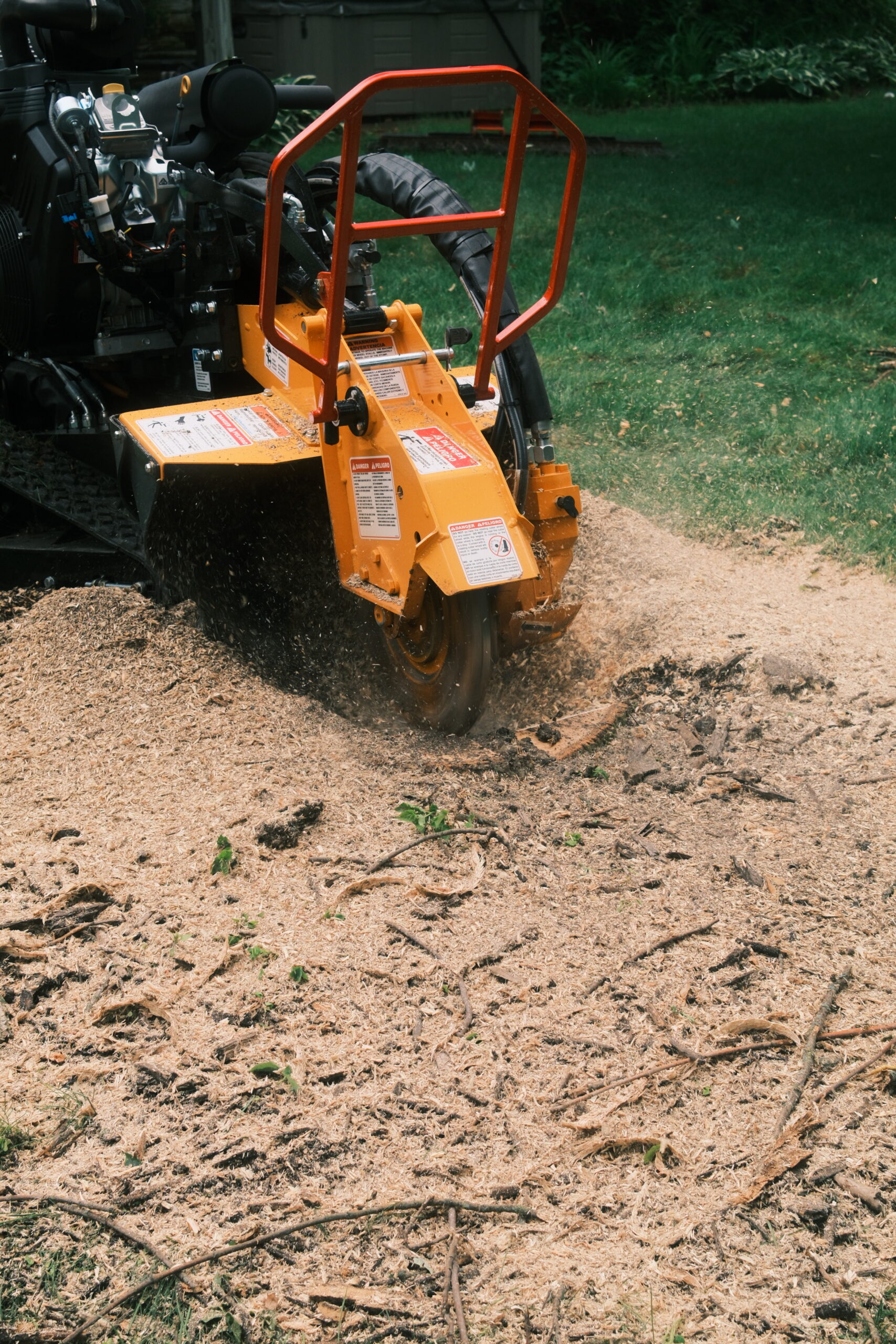
The first thing we look at on a lake lot is the path from the street to the stump. Stump grinders come in sizes for a reason: bigger machines cut faster but need a wider, flatter route. Narrow-access tracked grinders are built to squeeze through a standard gate — typically around 35 to 36 inches — and they run on rubber tracks that spread the weight instead of rutting a lawn.
What we are checking on the walk-through
Gate width at the narrowest point, not the widest. Overhead clearance where a deck or a soffit hangs low. Whether the path crosses a paver patio or a septic field. Whether there are steps, and how many. Whether a section of fence can come off temporarily — that one small step opens up more lake jobs than anything else.
If you want the detail on gate measurements before we come out, we wrote a whole piece on whether the machine will fit through your gate.
| Access Situation | What Happens On Site | Effect on the Job |
|---|---|---|
| Open driveway or 4 ft+ gate | Machine drives straight to the stump | Fastest, lowest cost |
| Standard 36 in gate | Narrow-access tracked grinder | Minor added time |
| Steps or terraced yard | Machine walked down carefully, extra hands | More labor, longer job |
| Steep grade toward shore | Approach planned off the slope for safety | Slower, safety driven |
| No side access at all | Neighbor access with permission, or reassess | Case by case |
Grinding Near the Shoreline
This is the question we get most on lake jobs, and the honest answer has two halves.
First half: grinding an existing stump is not the same thing as clearing living vegetation or excavating a hole. The tree is already gone. The cutting wheel works the stump and the root flare down to about 4 to 6 inches below grade, and the ground around it is left essentially as it was. That is a much lighter footprint than most shoreline projects.
Second half: Minnesota shoreland rules still govern what happens close to public water, and they are administered locally — by your city, not the DNR directly. The Minnesota DNR’s shoreland program defines a shore impact zone as the strip of land between the ordinary high water level and a line parallel to it at half the structure setback distance. Intensive vegetation clearing and land alteration inside that zone are restricted, and some work requires a permit from the city or county.
So the practical guidance: if the stump is well up in the yard, this rarely comes up. If it is down near the water, inside that shore impact strip, make one phone call to your city’s planning or zoning office and ask before anyone starts. Every lake city handles it a little differently, and the cost of asking is five minutes. We are always happy to wait on that answer rather than create a problem for a homeowner.
Keeping the grindings out of the lake
Regardless of permits, we do not leave a pile of loose wood chips sitting on a slope above the water. Chips are light, they float, and a single hard summer downpour will carry them straight down the grade. On lakeside jobs we pull the grindings back from the shoreline, fill the hole, and leave the surface level and stable rather than mounded and loose.
What Is Buried Under a Lake Lot
Before any grinding, utilities get located. In Minnesota that means Gopher State One Call — dial 811 or submit online, free of charge, at least two business days before the work. Under state law the utility operators then have that window to come out and mark their lines. Weekends and holidays do not count toward it, which is worth knowing if you are trying to schedule around a weekend at the lake.
Here is the part that catches people: 811 marks public utilities only. Private lines on your side of the meter are not their responsibility, and lake properties are absolutely full of them:
- Irrigation mainlines and lateral runs, often fed from a lake pump
- The lake pump’s own supply line running down to the water
- Invisible fence wire, usually a loop around the whole yard
- Low-voltage landscape lighting
- Power and data out to a dock, boathouse or lift
- Drain tile and downspout lines routed toward the shore
If you know where any of these run, tell us on the walk-through. If you have an irrigation contractor who installed the system, a sprinkler map is gold. What we will not do is guess — a cutting wheel does not negotiate with a $600 pump line. The same caution applies to grinding close to foundations, fences and utility lines anywhere on the property.
Slopes, Retaining Walls and Bluffs
Lake lots slope. That is the whole appeal, and it is also the constraint. A stump grinder is a heavy, low machine with a spinning wheel, and it wants level ground under it. On a grade we plan the approach so the machine sits stable and the wheel swings across the stump, rather than driving the machine into a position where gravity is doing the steering.
Retaining walls deserve a specific mention. A stump sitting right against a segmental block wall is a genuine judgment call. The roots may be woven through the base course, and the wall may be holding back the entire upper yard. In that situation we will grind what can safely be ground and leave the rest, rather than compromise a wall that costs many times what the stump removal does. Being straight with you about that is the job.
What about stumps you might just leave
Occasionally the right answer on a steep or sensitive shoreline spot is to leave a low stump in place for another year while the root mass helps hold soil. That is not us dodging work — it is a legitimate call on an erodible slope. If we think that is the case, we will say so. And if you are weighing your options generally, our comparison of grinding versus full stump removal lays out the tradeoffs.
What It Costs on a Lake Property
Pricing works the same way it does anywhere in the west metro: it is driven mainly by stump diameter, measured across the widest point at ground level, including the root flare. The working range around here is roughly $3 to $7 per inch of diameter, with most companies applying a minimum charge for a single small stump because the drive and setup cost the same either way.
What pushes a lake job toward the higher end is not the wood. It is the access. Hand-walking a machine down three terraces, working around a sprinkler system, or grinding on a grade all take longer, and time is what you are paying for. Multiple stumps on one visit go the other way — the per-stump cost drops once we are already on site.
We do not quote lakeshore jobs sight unseen, and you should be skeptical of anyone who does. A firm number comes after someone has looked at the path in and the ground around the stump. For the full breakdown, see our guide to stump grinding costs in Minnesota.
Get a Straight Answer on Your Lake Lot
If you have a stump somewhere between your driveway and the water, the fastest way to know what it takes is to have someone walk it. We will tell you honestly whether the machine fits, what we would do about the slope, and what it costs — and if the answer is complicated, we will explain why instead of padding a number. Family owned, licensed and insured, grinding stumps across the west metro for over 20 years, and we grind a full 4 to 6 inches below grade with the chips cleaned up and the surface left level.
We work all the way around the lake and beyond, including Wayzata, Excelsior, Deephaven, Tonka Bay, Orono, Shorewood, Mound, Minnetrista and Minnetonka — see the full service area and what we do on our services page.
Call or text (612) 501-0602, or request a free quote online.
Frequently Asked Questions
Do I need a permit to grind a stump near Lake Minnetonka?
Often no, because grinding an existing stump is not vegetation clearing or excavation. But shoreland rules are administered by your city, and land alteration inside the shore impact zone near the water can be regulated. If the stump is close to shore, call your city planning or zoning office first. It takes five minutes and removes all doubt.
How close to the water can you grind a stump?
Physically, right up to the shoreline if the machine can reach it safely and the ground is stable. The limits are practical and regulatory rather than mechanical: soft saturated soil, a steep bank, or local shoreland restrictions are what determine how close we work, not the grinder.
Can you get a stump grinder into a fenced lakeshore backyard?
Usually yes. Narrow-access tracked machines are built to pass through a standard gate around 35 to 36 inches wide. If your gate is narrower, taking one fence panel off temporarily solves it more often than not. We measure the tightest point on the walk-through before quoting.
Will grinding damage my irrigation system or invisible fence?
Not if we know where they are. Calling 811 marks public utilities only — irrigation, invisible fence, dock power, landscape lighting and lake pump lines are private and are not marked. Show us what you know about, or share a sprinkler map, and we plan the cut around it.
What happens to the wood chips on a sloped lakeside yard?
We pull them back from the shoreline, use them to fill the hole, and leave the surface level rather than mounded. Loose chips left on a grade above water will float and wash downhill in the first heavy rain, so they do not get left that way. Leftover chips make good mulch for beds once they age.
How much does stump grinding cost on a Lake Minnetonka property?
The general range is about $3 to $7 per inch of stump diameter, with a minimum charge for a single small stump. Difficult access, slopes and hand-walking the machine push a job toward the top of that range. Exact pricing depends on the stump and the site, so we quote after looking at it.
Can you grind a stump on a steep slope or next to a retaining wall?
Slopes, usually yes, with the approach planned so the machine sits stable. Retaining walls are a judgment call — if roots are woven into the base of a wall that is holding back your yard, we grind what is safe and tell you plainly what we are leaving and why.
Which lake communities do you serve?
All the way around Lake Minnetonka and across the west metro, including Wayzata, Excelsior, Deephaven, Tonka Bay, Orono, Shorewood, Mound, Minnetrista, Victoria and Minnetonka, plus Eden Prairie, Edina, Chanhassen, Chaska and the surrounding communities.