It is the first week of August, the yard has finally dried out, and the stump from that tree you took down in April is still sitting there collecting rainwater and mosquitoes. The question we field more than almost any other this time of year: is now a good time to grind it, or should I wait for fall?
The honest answer is that we grind stumps across the west metro in every month of the year, and there is no season where it simply cannot be done. But conditions change what the job looks like, how clean your yard comes out, and what you can do with the spot afterward. Here is the season-by-season breakdown.
Key Takeaways
- There is no bad season, but there is an easiest one. Late summer into early fall is the smoothest stretch of the year for stump grinding in Minnesota.
- Mid-August through mid-September is the lawn seeding window, so grinding in early August lines the spot up perfectly for seed.
- Spring thaw is the trickiest time — saturated ground means heavy equipment can leave ruts in a lawn.
- Winter grinding is possible, but frozen ground is hard on grinder teeth and you cannot finish the spot until the thaw.
- Season barely moves the price. Roughly $3 to $7 per inch of stump diameter is the year-round range; access and stump size matter far more than the calendar.
Table of Contents
- Stump Grinding Is a Year-Round Job Here
- Season by Season in Minnesota
- Why Early August Is a Sweet Spot
- What Frozen Ground Actually Changes
- Lead Times, Locates, and Access
- Frequently Asked Questions
Stump Grinding Is a Year-Round Job Here
A stump grinder does not care what month it is. It cares about four things: whether the ground is soft, wet, or frozen; whether the machine can physically reach the stump; whether snow or leaves are hiding rocks, roots, and pipes; and what you plan to do with the spot afterward. Every seasonal argument you will hear comes back to one of those four.
The wood itself barely changes. A silver maple stump that has sat for three winters grinds about the same in June as it does in October. What changes is everything around it — the turf you have to cross, the moisture in the soil, and how fast the yard recovers.
Season by Season in Minnesota
Spring: March through May
Spring is the season people want and the season that fights back hardest. Frost is coming out of the ground, snowmelt has nowhere to go, and spring rain lands on soil that is already saturated. Drive a machine across a lawn in that condition and you leave tracks that take the rest of the summer to heal. Once the ground firms up — usually sometime in May out here, though it varies year to year — spring turns genuinely good: the soil grinds easily, the lawn is actively growing, and late April into May is the second-best seeding window of the year.
Summer: June through August
Summer is the most predictable stretch. Dry, firm ground means the machine rolls across turf without sinking, access to tight backyards is at its best, and long daylight gets multi-stump jobs finished in a day. The catch is what comes after: mid-summer heat is the worst time to put grass seed down, because seedlings bake faster than you can keep up with a hose. That is not a reason to delay grinding. It is a reason to grind now and seed a few weeks later.
Fall: September through November
If we had to name one best season, this is it. The ground is still workable, machines run efficiently in cool air, and the lawn is heading toward dormancy so minor turf scuffing barely shows. It is also the last honest chance to get a stump out before the ground locks up. The average first freeze at the Twin Cities airport lands around the first week of October, and once homeowners scrape a windshield the phone starts ringing. If you want a stump gone before winter, calling in September beats calling in November.
Winter: December through March
Winter grinding is real and we do it, with tradeoffs. Frozen soil in the top several inches grinds more like rock than dirt — slower going, harder on cutting teeth, chips that come out in frozen clods. Deep snow hides the stump, the surface roots, and anything else in the work zone. The upside is real too: frozen ground carries equipment beautifully, so a machine that would rut a soft April lawn crosses it in February without leaving a mark. Some jobs are still better off waiting for a thaw, and we will tell you straight when that is the case.
| Season | Ground Conditions | Best For | Watch For |
|---|---|---|---|
| Spring | Saturated, soft | Storm cleanup, May seeding | Rutting during thaw |
| Summer | Dry, firm | Tight access, big jobs | Too hot to seed |
| Fall | Cool, workable | Almost everything | Busy schedules |
| Winter | Frozen, snow-covered | Lawn crossings, open dates | Slower grind, no cleanup |
Why Early August Is a Sweet Spot
Here is the part worth acting on rather than filing away. Minnesota lawns are cool-season grasses — Kentucky bluegrass and fescues — and they establish best when the soil is still warm from summer but the air has started cooling. That puts the prime seeding window at roughly mid-August through mid-September across the Twin Cities.
Kentucky bluegrass is slow out of the gate. It can take three weeks just to germinate and wants several more weeks of growth to root in before the ground freezes, which makes September 15 a practical cutoff. Now overlay the grinding job on that calendar: after a stump comes out you have to haul off the chips, backfill with clean topsoil, and let the spot settle before seed goes down. Grinding in the first half of August gives you two or three weeks of runway to be ready the moment the window opens. Our guide to planting grass after stump grinding covers that process, including the nitrogen problem that catches most homeowners off guard.
If the spot is headed for a patio, a shed pad, or a garden bed instead of lawn, the seeding calendar does not apply — grind whenever the ground is workable and build when you are ready. See our stump grinding services for what a standard job includes.
What Frozen Ground Actually Changes
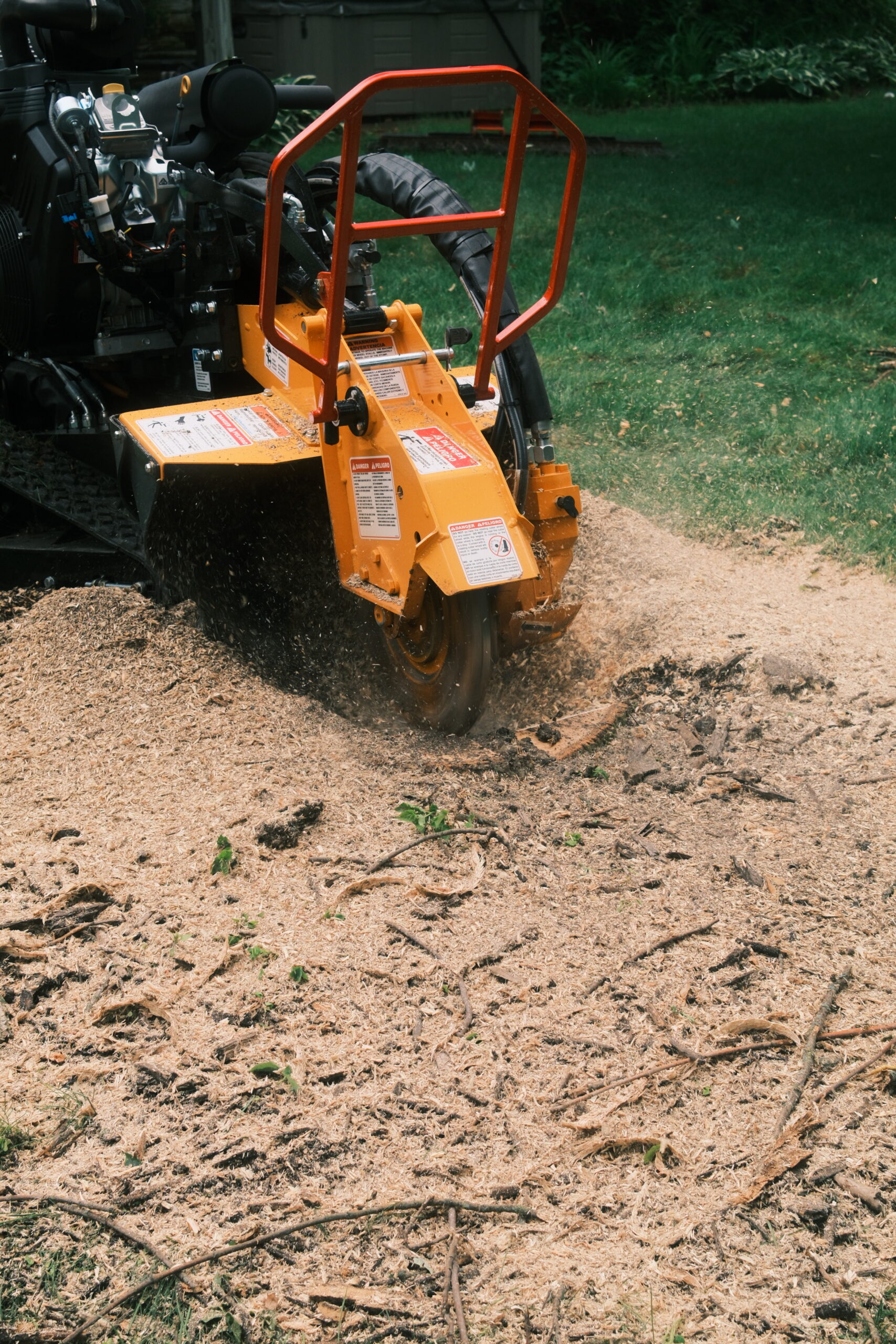
Standard practice on our jobs is to grind four to six inches below grade — deep enough that you can rake soil over the top, plant grass, and never catch the stump with a mower blade. In a Minnesota winter, that grind depth sits squarely inside the frozen layer. That is the whole issue in one sentence. Frozen wood and frozen soil are abrasive: teeth dull faster, the machine works harder, and a stump that takes forty minutes in September can take noticeably longer in January.
The bigger practical limitation is follow-through. Chips freeze into clumps that do not rake smooth, backfilling is pointless when the topsoil pile is a frozen block, and you cannot seed or plant until spring anyway. So a winter grind is often a two-stage project: the stump goes away now, the yard gets finished in May. If the stump is a tripping hazard or a mowing headache, there is no reason to wait. If the goal is a planted, finished-looking spot, wait for the thaw.
Lead Times, Locates, and Access
Utility locates
Minnesota law requires anyone excavating to notify Gopher State One Call at least two full business days ahead, not counting weekends or holidays. The service is free, and utility operators come mark the approximate location of buried public lines. We handle that step, but it means a stump job is rarely same-day.
What the public locate does not cover is private lines on your property: irrigation, invisible dog fence, low-voltage landscape lighting, and the gas run out to a grill or fire pit. Those are yours to point out, and they are the most common thing a grinder hits. Our guide to grinding near foundations, fences, and utility lines goes deeper.
Access and booking
The width of your gate is a bigger scheduling factor than the month. A backyard stump behind a 36-inch gate needs a narrow-access machine; a front-yard stump takes whatever is on the trailer. Tell us about gates, slopes, and soft spots when you call and the quote comes back accurate the first time. Spring cleanup and the September-to-October beat-the-freeze rush are the busiest stretches, so if your job has a deadline attached, get on the calendar a couple of weeks ahead rather than a couple of days.
Ready to Get That Stump Off Your List?
Every stump is a little different, and so is every yard. Describe the stump and where it sits, and we will give you a straight number and a realistic date. Pricing generally runs $3 to $7 per inch of diameter, but access, root spread, and stump count all move it — which is why we quote rather than guess. Our Minnesota stump grinding cost guide breaks down what drives the number.
Statement Stump Grinding is family owned, licensed, and insured, and we have been grinding stumps across the west metro for over 20 years. We serve Minneapolis and the western suburbs including Minnetonka, Eden Prairie, Wayzata, Excelsior, Chanhassen, and Edina — see the full service area. Call or text (612) 501-0602, or request a free quote online.
Frequently Asked Questions
What is the best time of year for stump grinding in Minnesota?
Late summer through early fall, roughly August into October, is the easiest window. The ground is firm enough to carry equipment without rutting, it is not yet frozen, and it lines up with the mid-August to mid-September lawn seeding window if you plan to grow grass in the spot.
Can you grind a stump in the winter?
Yes. Frozen ground grinds slower and wears teeth faster, and deep snow can make a job impractical, but winter grinding is routine in Minnesota. One real advantage is that frozen turf carries a machine without leaving ruts. The tradeoff is that cleanup and any planting have to wait for spring.
Does the time of year change the price?
Not much. Stump diameter, root spread, access, and stump count drive the cost far more than the calendar, and the general range stays around 3 to 7 dollars per inch of diameter year-round. Deeply frozen ground on a large stump can add time, which can affect the quote. Every job needs a look before we commit to a number.
How long after grinding can I plant grass?
You can start prepping immediately. Clear the wood chips out, backfill with clean topsoil mounded slightly above grade, and add slow-release nitrogen to offset the tie-up caused by leftover sawdust. Then seed during the window, which in the Twin Cities means mid-August to mid-September, or late April into May.
Do I need to call Gopher State One Call before stump grinding?
Yes, and Minnesota law requires at least two full business days of notice before excavating. The service is free. We handle the request, but the public locate only covers utility-owned lines. Private lines such as irrigation, invisible fence, landscape lighting, and gas runs to a grill are the homeowner’s responsibility to mark.
Should I grind the stump right after the tree comes down?
If the schedule allows, yes. There is no biological reason to wait, and the crew and equipment access are already sorted out. Leaving a stump for years does not make the wood harder to grind, but roots keep spreading and landscaping tends to grow in tighter around the work zone.