Most homeowners picture one kind of stump grinder: a big orange machine that chews a stump down to chips. In practice, the machines we bring to a job range from compact units that fit through a standard backyard gate to larger, heavier grinders built for open ground and oversized stumps. Picking the wrong one means a job that takes twice as long, a torn-up lawn, or a machine that simply will not reach the stump.
You do not have to choose the machine yourself, but understanding how the choice gets made helps you read a quote, prepare your yard, and spot when someone is guessing. Here is how stump size, access, slope and ground conditions decide what rolls onto your property.
Key Takeaways
- Access usually decides the machine, not the stump. The narrowest gate, path or corner on the route sets the maximum width.
- Compact grinders can handle big stumps by cutting in layers; it just takes longer.
- Bigger machines are faster on large stumps but are heavier, wider and harder on soft turf.
- Grinding depth is the same on every machine. Standard practice is 4–6 inches below grade.
- Measure your gate and send photos with your quote request. It is the fastest way to get an accurate estimate.
Table of Contents
- The Main Types of Stump Grinders
- Why Access Picks the Machine
- Stump Size, Hardness and Machine Choice
- Slopes, Wet Ground and Your Lawn
- Compact vs. Large: Side by Side
- How to Prepare Your Yard
- Frequently Asked Questions
The Main Types of Stump Grinders
Stump grinders all work the same way: a spinning cutter wheel with carbide teeth sweeps side to side across the stump, shaving it down in layers. What changes from machine to machine is weight, width, power and how the unit moves around a yard.
Compact and walk-behind machines
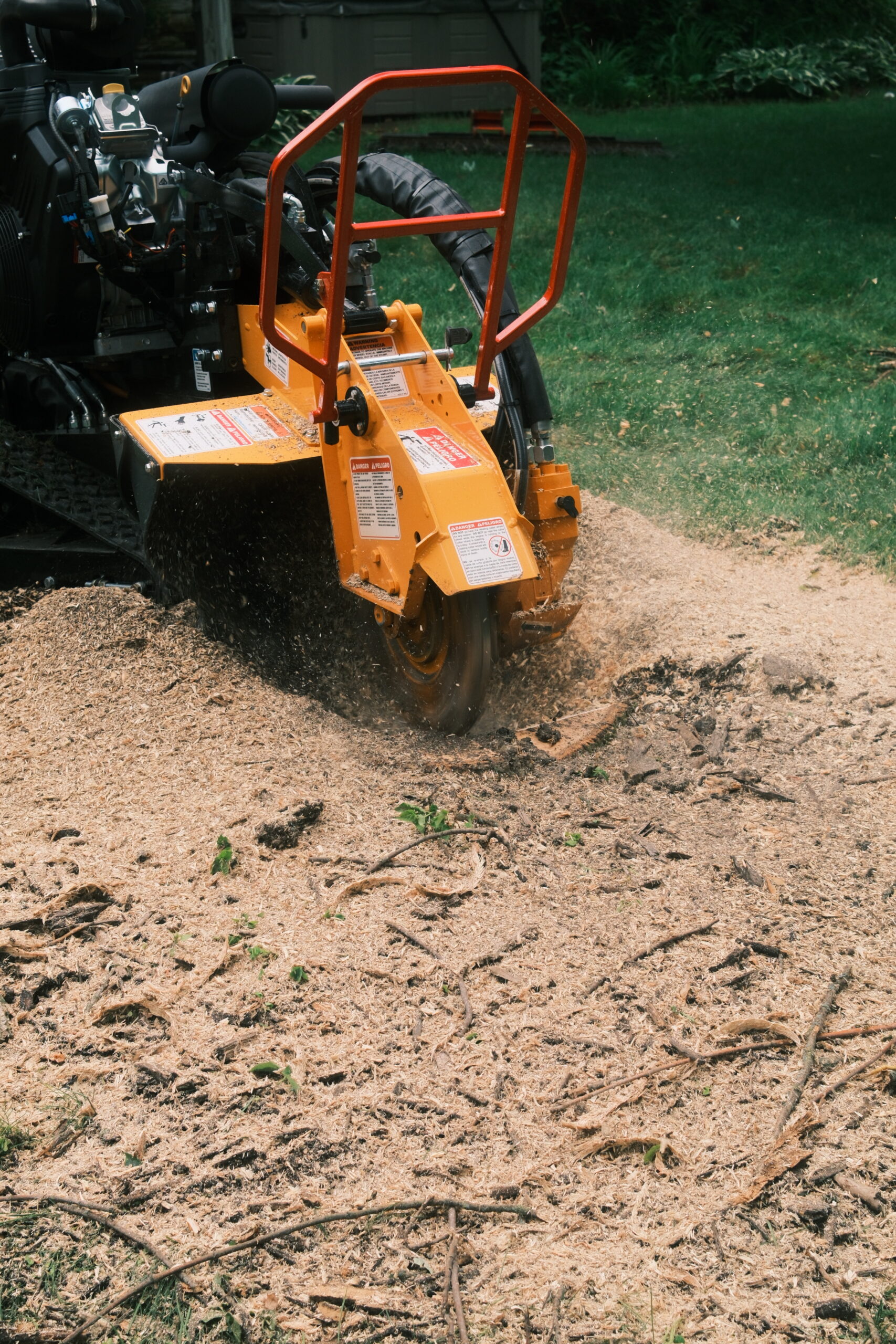
These are the small units you steer by hand or with a short control bar. They are narrow enough to pass through many residential gates, around house corners and between fences. They are the go-to for backyards, side yards and any stump you cannot reach with a bigger rig. Their limit is power and reach: a very large or very hard stump takes more passes.
Tracked self-propelled machines
Tracked grinders spread their weight over a wider footprint, which helps on slopes and soft ground. Many are built narrow so they still fit through a gate, and they can climb and turn in places a wheeled unit would struggle. They are a common middle ground between access and power.
Larger wheeled or tow-behind units
Bigger machines carry more power and can take on oversized stumps quickly, but they are wider and heavier. They suit open front yards, acreage, boulevard-style access and big clearing jobs with a lot of stumps. They are not the answer for a tight lot.
Why Access Picks the Machine
Ask any grinder operator what decides the equipment, and the honest answer is usually the route to the stump. A machine that cannot get there is useless, no matter how powerful it is.
Before a job, the things that matter are the narrowest point on the path, including gate posts, fence corners and landscaping; steps, curbs and grade changes; overhead branches and low decks; and whether the ground along the route is firm enough to carry the weight. A gate that looks wide can lose several inches to hinges and latches, which is why we ask for a measurement instead of an eyeball guess. We cover the gate question in detail in our guide to backyard stump grinding and gate access.
Dense older neighborhoods are where this comes up most. Lots in Edina and Hopkins often have narrow side yards and mature trees close to the house, so a compact machine is frequently the only workable choice.
Stump Size, Hardness and Machine Choice
Diameter
Diameter drives both time and price. A bigger stump means more wood to cut and a wider area to sweep. A compact grinder can still do the job, but it works down in layers and may need extra passes to reach the edges. A larger machine covers the same stump in less time. Our post on large vs. small stump grinding goes deeper on where the line falls.
Species and hardness
Not all wood cuts the same. Dense hardwoods such as oak take longer and wear teeth faster than softer species, and old, dry stumps can be harder than fresh ones. Rot works the other way, since soft or hollow wood cuts easily. If you know the species, tell us.
Roots and flare
A stump with wide surface roots needs more width and more sweeping than a clean cylinder of the same diameter. Roots at the surface are usually ground along with the stump when they are in the way.
Pricing in plain terms
Machine size is not a line item on most quotes. Pricing on this site runs roughly $3–$7 per inch of stump diameter, and exact pricing depends on the stump, access and cleanup, so a free quote is the only way to know for sure. Our full breakdown is in the Minnesota stump grinding cost guide.
Slopes, Wet Ground and Your Lawn
Ground conditions change which machine is the smart pick. On a slope, such as the lakeshore lots around Excelsior and Minnetonka, a tracked machine with a low center of gravity is steadier than a wheeled one, and the operator may grind in a different pattern to stay balanced.
Wet soil is the other big factor. A heavy machine on saturated turf leaves ruts, and in a Minnesota fall that is a real risk. We walk through what changes in the rain in our guide to grinding on wet ground. Sometimes the best answer is a lighter machine, and sometimes it is waiting a few days for the ground to firm up.
Any grinder leaves a patch of disturbed ground and wood chips at the stump itself, and that is normal. What you want to avoid is damage along the route, and a clear path plus the right machine keeps that to a minimum.
Compact vs. Large: Side by Side
| Factor | Compact / Tracked | Larger Machine |
|---|---|---|
| Gate and tight access | Often fits | Needs open access |
| Very large stumps | Slower, more passes | Faster |
| Soft or wet turf | Lighter on the ground | Higher rut risk |
| Slopes | Tracked units are steadier | Depends on the unit |
| Many stumps in open ground | Works, but slower | Efficient |
| Grinding depth | 4–6 inches below grade | 4–6 inches below grade |
How to Prepare Your Yard
You do not need to do much, but a few minutes of prep saves time on the day.
Measure and clear the route
Measure the narrowest point between the street and the stump and move planters, hoses, toys and patio furniture out of the way. Unlatch or prop open the gate if you can.
Mark what is underground
Sprinkler heads, invisible fence wire and landscape lighting lines are easy to hit. Point them out when you book. We cover this in our guide to grinding around sprinkler lines and invisible fences. For anything beyond your own yard, Minnesota law calls for a locate before digging, which we explain in our Gopher State One Call guide.
Send photos and a measurement
Photos of the stump, the path to it and the gate, along with an approximate diameter, let us tell you in advance what machine fits. If you are unsure how to size the stump, see how to measure a stump for a grinding quote.
Get the Right Machine Sent to Your Yard
We would rather tell you up front what will and will not fit than discover it on the day. Family owned, licensed and insured, and grinding stumps across the west metro for over 20 years, we grind every stump 4 to 6 inches below grade, clean up the chips and leave a level surface.
We serve Minneapolis and the western Twin Cities, including Minnetonka, Eden Prairie, Wayzata, and every community in between. See everything we do on our services page, or learn how to compare stump grinding quotes.
Call or text (612) 501-0602, or request a free quote online.
Frequently Asked Questions
How big is a stump grinder?
Compact units can be about three feet wide or a little narrower, which is what lets them fit through many backyard gates. Larger tracked and wheeled machines are wider and heavier and need open access. The right size depends on your stump and your site, not on bigger always being better.
Does a bigger stump grinder cost more?
Not directly. Pricing on this site runs roughly $3–$7 per inch of stump diameter, and what really moves the number is diameter, access, roots and the number of stumps. A free quote based on your actual stump is the only way to get an exact figure.
Can a small grinder handle a large stump?
Often yes, it just takes more passes and more time. Compact machines can work through big stumps by cutting in layers, which is sometimes the only option when the gate is narrow. Very large or very hard stumps may call for a bigger unit, and a quote visit settles it.
Will the grinder tear up my lawn?
Any machine leaves some disturbance at the stump itself. Tracked and compact machines spread their weight better than a heavy wheeled unit, and ground protection or careful routing helps on soft turf. Wet ground raises the risk, so timing matters as much as machine size.
What if my stump is behind a fence or in a tight side yard?
Measure the narrowest point on the route, including gate posts and any tight corner, and tell us when you request a quote. A compact walk-behind or narrow tracked machine can often get through where a larger one cannot. If nothing fits, we will tell you before the job, not during it.
Do you need to see the stump before quoting?
Photos plus a stump diameter and the gate or path width are usually enough for a solid estimate. For awkward sites, slopes or lakeshore lots, a quick look in person can prevent surprises. Quotes are free either way.
How deep does the grinder cut, and does machine size change that?
Standard practice is 4–6 inches below grade whatever machine is used. A bigger machine can finish faster on a large stump, but depth is a job-quality standard, not a machine feature.
Is a handheld or walk-behind grinder cheaper to run on small jobs?
Small stumps in tight spots are usually quick work for a compact machine, but every job still has setup time, which is why very small stumps often fall under a minimum charge. Grinding several stumps in one visit spreads that setup cost out.