The first thing most people ask when they call about a big stump is some version of “can you even grind something that size?” The answer is almost always yes. A 40-inch silver maple stump and a 6-inch lilac stump come out of the ground with the same machine and the same basic method. What changes is how long it takes, what the chips look like when we are done, and how we plan the job.
This post walks through what is actually different about grinding a large stump versus a small one — time, cost, access, cleanup and the hole left behind — so you know what to expect before we show up, and so you can tell when a quote is priced honestly.
Key Takeaways
- There is no practical upper limit on stump size for grinding. Big stumps just take more passes and more time.
- Diameter drives the price, but volume drives the work. Doubling the diameter roughly quadruples the wood the cutter wheel has to chew through.
- Large stumps produce a surprising volume of chips — often several wheelbarrow loads, more than most homeowners expect.
- Small stumps are quick but add up. A row of shrub stumps is often priced by the group or as a minimum trip charge.
- Cost is measured at the widest point at ground level, including flared roots. That is why a stump measures bigger than the trunk did.
- Exact pricing depends on the stump. Wood type, root flare, age and access all move the number, which is why we look before we quote.
Table of Contents
- Is There a Stump Too Big to Grind?
- Why a Big Stump Is More Than Twice the Work of a Medium One
- Large vs. Small Stumps: What Changes on the Job
- Small Stumps: Fast, but There Is a Catch
- What a Large Stump Job Actually Looks Like
- Chips, Holes and Cleanup by Size
- Frequently Asked Questions
Is There a Stump Too Big to Grind?
Not in any yard we have worked in around the west metro. A professional stump grinder does not need to lift the stump or pull it out; it grinds it into chips a fraction of an inch at a time with a spinning cutter wheel. Whether that stump is 8 inches across or 60, the wheel does the same thing — it just does it for longer.
The stumps that make people nervous are the old cottonwoods, silver maples and bur oaks that were planted when these neighborhoods were built. We have ground plenty of stumps over four feet across in Minnetonka, Edina and Wayzata. They take a while, but they come out. If you have a stump you think is too big, it is worth a look before you assume it has to stay.
What actually limits a job is not size. It is access (can the machine get to it?), what is buried nearby (utilities, irrigation, a foundation), and whether there is somewhere to leave the chips. We covered those in our posts on gate access and grinding near foundations and utilities.
Why a Big Stump Is More Than Twice the Work of a Medium One
Stump grinding is quoted by diameter, and the going range in the Twin Cities is roughly $3 to $7 per inch depending on the stump and the company. That makes it sound like a 40-inch stump is simply twice the job of a 20-inch stump. It is not, and understanding why helps explain what you are paying for.
The cutter wheel has to remove a volume of wood, not a line across the top. The area of a circle grows with the square of its diameter, so a 40-inch stump has about four times the cross-section of a 20-inch one. Grind both to the same depth and you have removed roughly four times the wood. Add the root flare — the buttress roots that spread out at the base of a mature tree — and a big stump gets bigger still below the surface.
So why is it still priced per inch?
Because it is simple, and because a good per-inch rate already assumes that big stumps take longer per inch than small ones. Per-inch pricing is a shorthand, not a formula that captures everything. Most grinders, us included, will look at photos or the stump itself before committing to a number on anything large. Our guide to measuring a stump shows how to take the measurement so your quote is accurate the first time.
Large vs. Small Stumps: What Changes on the Job
Here is a plain comparison of what you can expect on either end of the spectrum. Times are rough and assume a straightforward yard with decent access.
| Factor | Small stump (under 12 in.) | Large stump (over 30 in.) |
|---|---|---|
| Grinding time | 10–20 minutes | 1–3 hours |
| Chip volume | A few buckets | Several wheelbarrow loads |
| Root flare | Minimal | Wide, often the slowest part |
| Machine needed | Any walk-behind unit | Larger tracked or tow-behind grinder |
| Typical pricing | Often a minimum charge | Per inch, quoted after a look |
| Hole left behind | Shallow, easy to fill | Deep and wide, needs real backfill |
The middle of the range — the 15 to 25 inch ash, maple and spruce stumps that make up most of our calls — falls in between: usually under an hour, a manageable chip pile, and a hole you can fill with a few bags of topsoil.
Small Stumps: Fast, but There Is a Catch
Small stumps are the easy part of this business. A lilac, arborvitae, crabapple or young ash stump under a foot across is gone in minutes. The catch is that no company can send a truck, trailer and operator across town for a 10-minute job at $5 an inch. That is why nearly every grinder has a minimum charge, and why a single small stump often costs about the same as a stump twice its size.
The way to get real value on small stumps is to batch them. If you have a row of overgrown shrubs, a few volunteer boxelders along the fence, and a dead spruce, having them all ground in one visit spreads the trip cost across the whole job. We wrote about that math in Grinding Multiple Stumps: Why One Trip Beats Five. Neighbors sometimes coordinate for the same reason.
Shrub stumps and buckthorn
Hedge and shrub stumps are technically small but can be fussy: multiple stems, roots woven into a fence line, and often rock or landscape edging right up against them. Buckthorn is the classic example — small stumps, tough wood, and a strong urge to resprout if you leave anything alive. Our buckthorn post covers how to keep it from coming back.
What a Large Stump Job Actually Looks Like
A big stump changes the plan in a few specific ways.
Machine choice
A compact walk-behind grinder will eventually get through a 40-inch oak, but “eventually” is the problem. We bring a larger tracked machine for big stumps whenever access allows. More horsepower and a bigger cutter wheel mean fewer, deeper passes and a job measured in an hour or two instead of an afternoon. It also means we need a path roughly 36 inches wide to get it into the backyard.
The root flare is the slow part
On a mature tree the visible stump is only the middle of the job. The buttress roots can extend the ground-level footprint by a foot or more in every direction, and those roots are dense, often grit-filled from years of soil contact, and sitting right where the mower needs to go. Grinding the flare down properly is what makes the difference between a spot you can seed and a spot with hard wooden ridges hiding under two inches of dirt.
Depth
We grind 4 to 6 inches below grade as standard, which is plenty for lawn. On a very large stump, the center of the stump may need to go a bit deeper to make room for enough topsoil to hold moisture for new grass. If you plan to replant a tree in the same spot, tell us ahead of time; that is a different depth and a different conversation, covered in our post on planting a tree where a stump was.
Old vs. fresh
Age cuts both ways. A stump that has been dead for several years is usually softer and grinds faster, especially maple, cottonwood and birch. Oak and black walnut stay hard for a long time. A freshly cut green stump of any species is wetter and heavier but still grinds cleanly; it just throws heavier chips.
Chips, Holes and Cleanup by Size
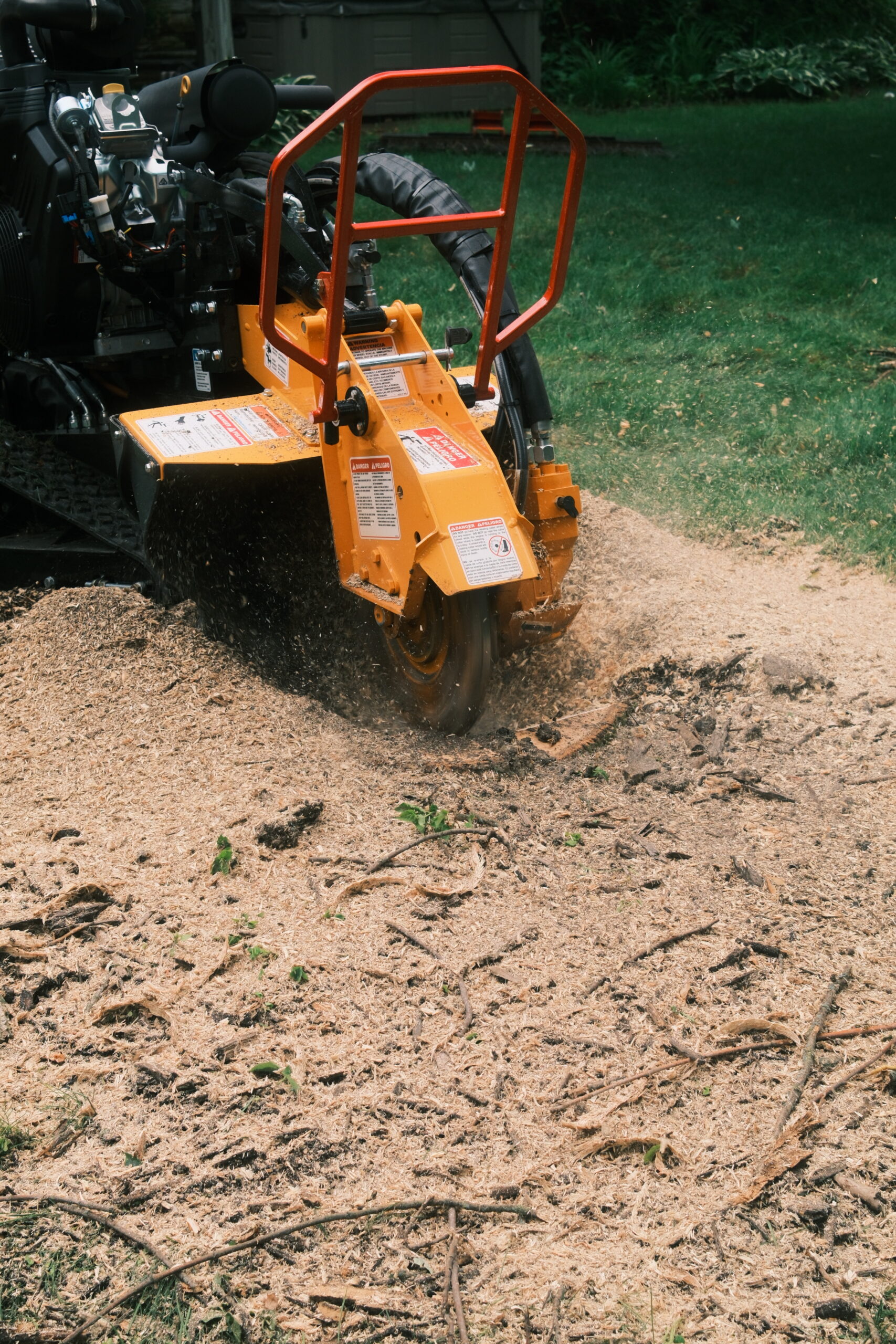
The one thing that catches homeowners off guard on big stumps is the chip pile. A 36-inch stump ground 6 inches deep, flare included, can produce a mound of chips several feet across and a couple of feet high. That is more than fits in a garbage can, and it is more than you want to leave sitting on the lawn for a month.
Standard practice on our jobs is to rake the chips back into the hole, mound the surplus neatly, and leave a level surface. Those chips are useful — they make a fine mulch for beds and paths once they age — but they are the wrong thing to grow grass in. If you want lawn back, the chips need to come out of the hole and be replaced with topsoil. On a big stump that is a real volume of soil, sometimes a yard or more. Our guides on what to do with stump grindings and planting grass after stump grinding walk through the whole process.
Small stumps are the opposite: a bucket of chips, a shallow dip, a bag of topsoil and a handful of seed. Mid-September is still inside the best fall seeding window in the Twin Cities, so a small stump ground this week can be lawn by the time the leaves drop.
Big Stump, Small Stump, Same Standard
We grind them all the same way: measured honestly, ground 4 to 6 inches below grade, flare included, chips managed and the spot left level. Family owned, licensed and insured, and grinding stumps of every size across the west metro for over 20 years.
We serve Minneapolis and the western Twin Cities, including Eden Prairie, Chanhassen, Excelsior, Hopkins and every community in between. See what we do on our services page, or read our guide to what stump grinding costs in Minnesota.
Call or text (612) 501-0602, or request a free quote online.
Frequently Asked Questions
Can you grind a really large stump?
Yes. Stump grinders do not lift or pull the stump; they chip it away a little at a time, so size mostly affects how long the job takes. We regularly grind mature maple, oak and cottonwood stumps over three and four feet across in the west metro.
How long does it take to grind a large stump?
A stump over 30 inches across typically takes one to three hours with a full-size machine, depending on species, root flare and access. A small stump under a foot across is usually done in 10 to 20 minutes.
Why does a big stump cost more per inch than a small one?
Because the amount of wood grows with the square of the diameter. A 40-inch stump has roughly four times the wood of a 20-inch stump at the same depth, plus a wider root flare. Per-inch rates are a shorthand, and most grinders want to see a large stump before quoting it.
Is there a minimum charge for a small stump?
Almost always. The truck, trailer and operator cost the same to send out for a ten-minute job as for an hour, so most companies set a minimum. Batching several small stumps into one visit is the best way to get value.
How much wood chip does a large stump produce?
Often several wheelbarrow loads — a mound a few feet across and a foot or two high is normal for a 36-inch stump ground 6 inches deep with the flare included. The chips can be left mounded in the hole or used as mulch.
Do you need a bigger machine for a big stump?
Not strictly, but it helps a lot. A larger tracked grinder with more horsepower and a bigger cutter wheel finishes a big stump in a fraction of the time a compact walk-behind unit would take. We match the machine to the stump and the access.
Do you measure the stump or the trunk?
The stump, at its widest point at ground level, including the root flare. That is the wood that has to be ground. It is usually larger than the trunk diameter you remember from the standing tree.
Can I fill the hole from a large stump with the chips?
You can for a temporary fill, but chips will not grow grass and the spot will sink as they decompose. For lawn, remove most of the chips, backfill with topsoil mounded slightly above grade, and seed in the right window.