Most homeowners have never watched a stump get ground. They book the job, a truck shows up, there is a lot of noise for a while, and then the stump is gone. That gap between “scheduled” and “done” is where the questions pile up: Do I need to be home? Will the machine tear up my lawn? What is actually happening under that shroud of flying chips? What am I supposed to do with the pile afterward?
Here is the whole stump grinding process, start to finish, the way we run it on a typical west metro job. Nothing here is complicated, but knowing the sequence ahead of time makes the day go smoother for you and for us, and it makes it a lot easier to tell a careful operator from a sloppy one.
Key Takeaways
- You usually do not need to be home, as long as the stump is marked, the gate is unlocked and we have talked through the details beforehand.
- The grinding itself is the short part. A typical 20-inch stump takes 20 to 40 minutes on the machine; setup, cleanup and moving around take the rest.
- We grind 4 to 6 inches below grade as standard, deeper on request, and we chase the visible surface roots.
- Chips stay on site by default and get raked back into the hole. Hauling is an add-on you can ask for.
- Utility locates, sprinkler heads and buried objects are the things most likely to slow a job down — tell us about them up front.
- The spot will settle over the next year or two as roots decay. That is normal, not a sign the job was done wrong.
Table of Contents
- Before We Arrive: What You Should Do
- Arrival and Walkthrough
- Getting the Machine to the Stump
- The Grinding Itself
- Cleanup and What Gets Left Behind
- After We Leave: The Next Few Weeks
- Frequently Asked Questions
Before We Arrive: What You Should Do
A good job starts before the truck is in your driveway. Three things make the biggest difference.
Mark anything buried near the stump
Irrigation heads and lines, low-voltage landscape lighting, invisible dog fence wire, a downspout drain, an old clothesline post footing. None of these show up on a public utility locate, and all of them are within reach of a cutting wheel that goes six inches down. Flags, spray paint, or even a text with a photo and an arrow is enough. If you do not know, say so and we will work more cautiously.
Public utility locates
Gopher State One Call (dial 811) is Minnesota’s free locate service for public utilities like gas, electric and telecom. Stump grinding is shallow work, but shallow is not zero, and service lines are sometimes buried far closer to the surface than they should be. If a stump is near a meter, the street, or the path a line would logically run, we want it located before we start. We can talk through whether your stump warrants a locate when we quote. Our post on grinding near foundations, fences and utility lines covers this in more detail.
Clear the path
Move vehicles, trailers, kids’ toys and patio furniture off the route from the street to the stump. Unlock the gate. If a neighbor’s yard is the only way in, ask them ahead of time. A few minutes of prep saves us wandering around looking for a way through.
Arrival and Walkthrough
When we pull up, the first thing we do is walk the job, ideally with you but it works fine without. We confirm which stump (people are surprised how often there is more than one candidate), check the access route, look at what is near the stump — foundation, fence, sidewalk, AC condenser, garden bed — and confirm the depth and cleanup you were quoted.
This is also where we look for trouble. Rocks packed against the trunk flare, old fence wire grown into the wood, a chunk of concrete somebody poured around a post years ago. Steel and stone destroy cutting teeth, so we would rather find them with our eyes than with the wheel. If the stump was cut high, we may take it down closer to the ground with a chainsaw first, which cuts grinding time.
If you have booked several stumps, we plan the order so the machine only makes one pass through the yard. That matters more than it sounds — it is a big part of why grinding multiple stumps in one visit is so much cheaper per stump.
Getting the Machine to the Stump
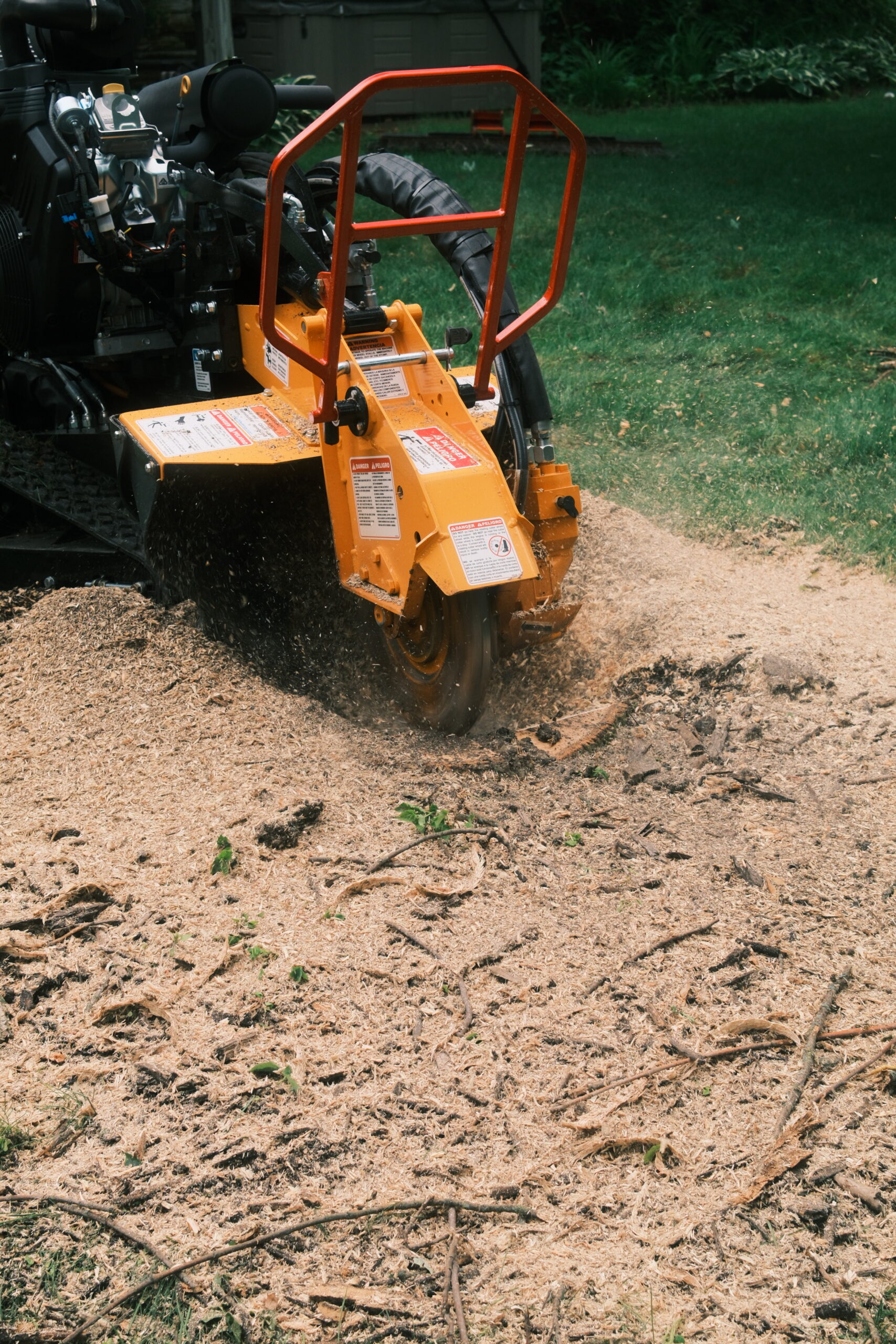
A stump grinder is a heavy machine with a spinning steel wheel on the front, studded with carbide teeth. Ours are self-propelled tracked units, which spread the weight and are far gentler on turf than wheeled models, especially on soft ground. For most yards the machine drives straight in. Where it cannot, a narrow-access unit or, on very tight sites, a smaller handlebar grinder does the work, just more slowly. If you are unsure whether your gate is wide enough, this guide to backyard access will tell you what to measure.
Once in position, we lay down guards and often a plywood or plastic barrier between the stump and anything fragile: siding, windows, a car parked too close to move, a neighbor’s fence. Grinders throw chips hard and far. The shroud on the machine catches most of it, but not all, and a chip through a window is a bad way to end a job.
The Grinding Itself
The wheel is lowered onto the front edge of the stump and swept side to side, taking off an inch or two with each pass. The operator works front to back, then drops the wheel and repeats, layer by layer, until the top of the stump is below the level of the surrounding lawn. Think of it as a very aggressive router, not a saw. The wood does not come out in chunks; it comes out as a mix of chips and shredded fiber.
Depth
Our standard is 4 to 6 inches below grade. That is enough to lay sod or seed grass over the spot with room for topsoil, and enough to kill the stump. If you plan to plant a tree or shrub in the same spot, or pour a slab or set a post, we go deeper — 8, 10, 12 inches or more depending on the stump and the soil. Depth is one of the main things that changes the price, so it is worth settling before the day. We have a full write-up on how deep stump grinding goes and why.
Surface roots
Many trees, silver maple and cottonwood especially, send thick roots along the surface for several feet out from the trunk. We chase the visible ones out until they drop below grade so you are not left with humps in the lawn. Roots that are already underground stay there and decay on their own; digging them all out is removal, not grinding, and a different job entirely.
How long it takes
Time on the machine depends on diameter, species, depth and what is in the ground. Here is what a typical day looks like.
| Stage | Typical Time | What Affects It |
|---|---|---|
| Walkthrough | 5–10 min | Number of stumps, obstacles |
| Access and setup | 10–20 min | Gate width, distance, slope, guards |
| Grinding, small stump (under 12 in.) | 10–20 min | Species, depth |
| Grinding, medium (12–24 in.) | 20–45 min | Hardwood vs. softwood, roots |
| Grinding, large (over 30 in.) | 1–2+ hrs | Rocks, buried debris, root flare |
| Cleanup | 10–30 min | Chip volume, rake-in vs. haul |
Oak and elm are dense and slow. Silver maple, cottonwood and pine are fast. A rocky root ball can double any of these numbers. If you want to plan your day around it, read our realistic stump grinding timeline.
Cleanup and What Gets Left Behind
Grinding a stump produces a pile of chips considerably bigger than the stump was, because the wood fluffs up as it is shredded. A 24-inch stump ground to depth can easily produce a wheelbarrow or three of grindings.
The standard finish is to rake the chips back into the hole, mound them slightly, and leave the area level and tidy. We rake chips off the surrounding lawn, patio and driveway, and blow off hard surfaces. What you are left with is a soft, chip-filled circle roughly where the stump was.
If you would rather have the hole cleared out — because you are seeding right away, or you just do not want the pile — chip haul-off is an add-on. We shovel out the grindings and leave you with an open hole ready for topsoil. Some people keep the chips for beds and paths; our post on what to do with stump grindings covers the good uses and the mistakes.
Before we drive off, we walk the job again. Depth checked, roots chased, chips managed, nothing damaged, gate closed. If you are home we show you; if not, we text you a photo.
After We Leave: The Next Few Weeks
Two things happen after a grind that catch people off guard. The first is settling. The hole is full of loose chips and the ground beneath it is laced with roots that will decompose over one to three years. The spot will sink. If you plan to reseed, clear the chips, backfill with topsoil mounded a little above grade, and expect to top it up once or twice. Our guide to planting grass after stump grinding walks through it, including why fresh chips starve new grass of nitrogen.
The second is sprouting. Some species — boxelder, silver maple, cottonwood, elm, and above all buckthorn — can push suckers from roots left in the ground. Grinding removes the stump’s ability to resprout from the crown, and for most trees that is the end of it. If you do see shoots, cut or mow them repeatedly and they run out of stored energy. Persistent species like buckthorn may need more attention.
Neither of these means the job was done poorly. They are what wood in the ground does. What you should not see is a stump still visible above the soil, big surface roots left as trip hazards, or chips broadcast across your lawn and your neighbor’s. Those are the marks of a rushed job.
Ready to Get the Stump Out?
This is how we run every job, whether it is one small stump behind a garage in Hopkins or a dozen storm-damaged ash along a driveway in Orono. Walk it, protect what is around it, grind it to the depth you were quoted, chase the roots, clean up, and check the work before we leave. Family owned, licensed and insured, grinding stumps across the west metro for over 20 years.
We serve Minneapolis and the western Twin Cities, including Minnetonka, Eden Prairie, Edina, Hopkins, Orono, and every community in between. See what we do on our services page, or read our guide to what stump grinding costs in Minnesota.
Call or text (612) 501-0602, or request a free quote online.
Frequently Asked Questions
Do I need to be home for stump grinding?
Usually not. If the stump is clearly identified, the gate is unlocked, anything buried nearby is marked, and we have agreed on depth and cleanup, we can do the job while you are at work and text you a photo when it is finished. Being home for the first few minutes is helpful on complicated sites, but it is not required.
How loud and messy is stump grinding?
Loud. A grinder runs at roughly the volume of a large lawn mower or chainsaw, so it is a daytime job and we keep neighbors in mind. Mess is contained by the machine’s shroud and by guards we set up, and we rake and blow off the surrounding area before we leave. Expect a chip-filled circle where the stump was, not chips across the yard.
Will the grinder damage my lawn?
Tracked machines spread their weight and leave little more than flattened grass on firm ground. On soft, saturated turf a machine can leave marks, which is one reason we watch the weather and may suggest waiting a few days after heavy rain. We also use mats over fragile areas when needed.
How deep do you grind?
Our standard is 4 to 6 inches below grade, which is enough to grow lawn over the spot. If you plan to replant, build, or pour concrete there, we can go deeper — just tell us when you book so it is reflected in the quote.
What happens to the wood chips?
By default we rake them back into the hole and leave the spot level. If you want the hole cleared, we can haul the grindings away as an add-on. Chips make decent mulch for beds and paths once they have aged a few months.
Do I need to call Gopher State One Call before stump grinding?
Gopher State One Call (811) locates public utilities and is free. For a stump in the middle of a yard away from meters and the street, the risk is low, but for stumps near the house, the road or a known line, we want a locate before we start. It does not cover private lines like irrigation or landscape lighting, so mark those yourself.
What should the spot look like when you are done?
The stump should be entirely below the surrounding soil level, visible surface roots chased down, the hole filled and mounded with chips (or cleared if you asked for haul-off), and the lawn and hard surfaces around it raked and blown clean. Anything less is not finished.
Can I get a quote without someone coming out?
Often, yes. A couple of photos with something for scale, a rough diameter measured at ground level, and a note about access are usually enough for us to give a firm number. Larger or more complicated stumps may need a quick site visit. Either way the quote is free.