Drive through Wayzata, Orono, Deephaven or Shorewood and you will notice the same thing: big lots, mature trees, long driveways and a lot of property tucked back from the road. That is what makes these neighborhoods so pleasant to live in, and it is also what makes a stump job here a little different from a stump in a standard subdivision lot.
We grind stumps across the west metro, and the north and south shores of Lake Minnetonka bring their own set of questions: how does a machine get to the back of a long property, what happens when the stump is close to the shoreline, and how do you deal with the sheer size of the old trees that grew there. Here is how we think about stump grinding on these lakeshore and large-lot properties.
Key Takeaways
- Access decides the job more than the stump does. Gates, steep slopes, landscaping and long distances from the street all affect how we get the machine in.
- Mature trees mean big stumps. Large-diameter stumps cost more because price follows diameter, roughly $3–$7 per inch, with the exact number set by a free quote.
- Near-shoreline stumps need care. Loose chips and bare soil can wash toward the water, so cleanup and ground cover matter.
- Call 811 before grinding. Buried utilities, irrigation and lighting are common on established properties.
- Grouping several stumps in one visit is the best way to save on larger properties where more than one tree has come down.
Table of Contents
- What Makes Lakeshore and Large Lots Different
- Getting the Grinder to the Stump
- Stumps Near the Water
- Big, Old Trees and Big Stumps
- Utilities, Irrigation and Landscaping
- What It Costs
- Frequently Asked Questions
What Makes Lakeshore and Large Lots Different
A stump in a typical suburban yard is usually a short walk from the street, with a flat lawn around it. On a lakeshore or estate-style property, that is rarely the case. The tree may be downslope toward the water, behind a house, past a garden, or at the far end of a long drive. There may be mature plantings, stone walls, retaining walls and irrigation between the street and the stump.
None of that makes the work impossible. It just means we look at the route and the surroundings before we look at the stump. When we quote, a photo of the stump and a note on where it sits relative to the house, the driveway and the water gives us most of what we need.
If you want the broader picture of how this works on the lake, we cover it in our guide to stump grinding on Lake Minnetonka properties. This post focuses on the Wayzata, Orono, Deephaven and Shorewood side of things.
Getting the Grinder to the Stump
Machine size and the route in
We run grinders in different sizes. A compact machine fits through a standard gate and along narrow side yards; a larger one is faster on big stumps but needs a wider path. On a property with a long route, the question is whether we can drive in or whether the machine has to be walked in on a narrow path. Our guide to choosing between compact and large grinders explains the tradeoff, and our post on backyard gate access covers what to measure.
Slopes
Lakeshore lots often slope toward the water. Grinding on a slope is slower and takes more care, because the machine has to stay stable and the operator needs solid footing. If the stump sits on a steep bank, tell us up front. It is one of the details that most changes how we plan the visit.
Protecting what is already there
Established properties tend to have lawns, gardens and hardscape worth protecting. We keep the machine on the route we agree on, and we do not drive across plantings. If there is a spot we should stay off, point it out when we arrive.
Stumps Near the Water
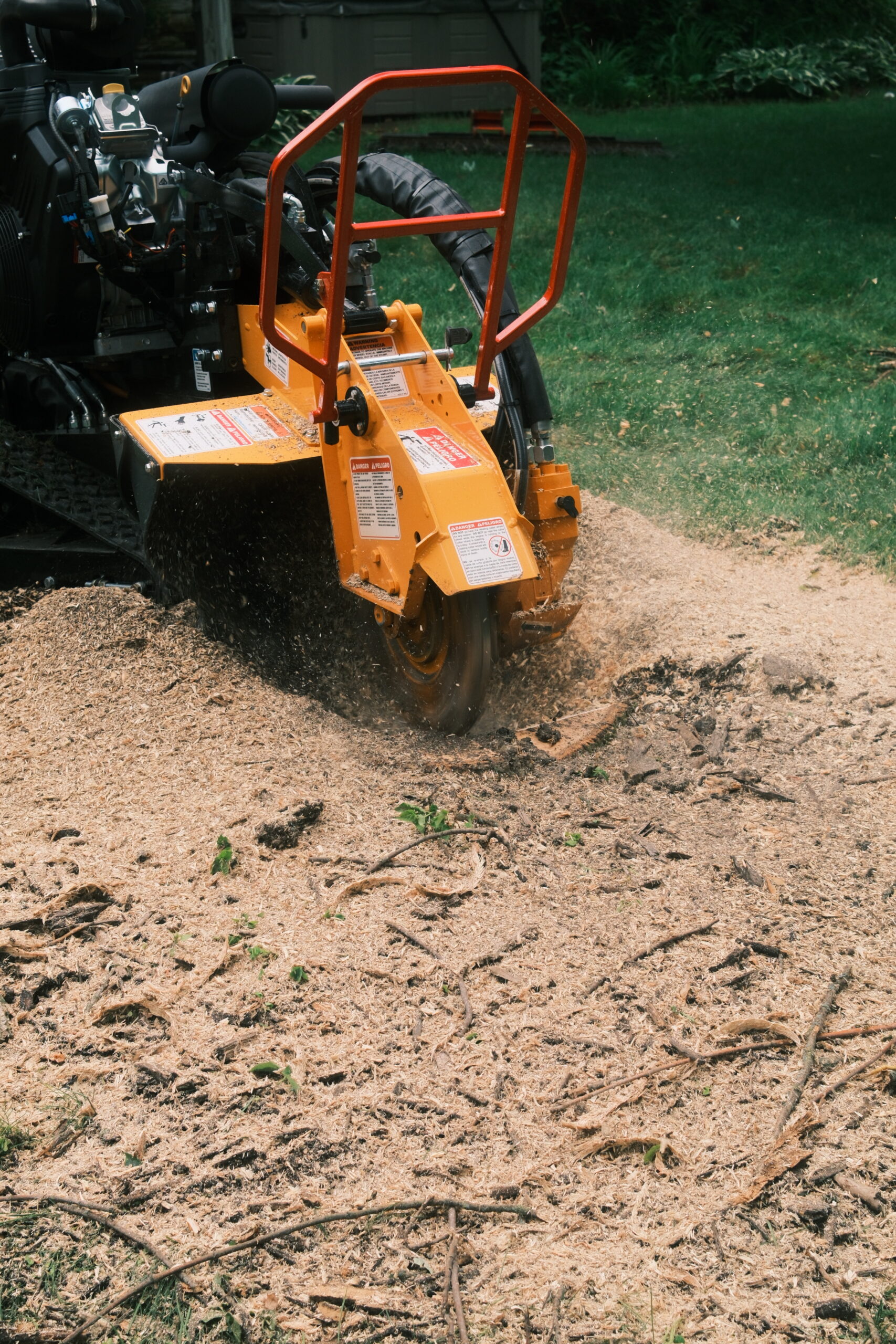
A stump close to the lake or a drainage path raises a practical concern that inland yards do not have: what happens to the loose chips and bare ground afterward. Left alone through a hard rain, a pile of fresh grindings and exposed soil can move downhill. On a shoreline lot you want that material staying on the property, not washing toward the water.
The simple fixes are the ones we use on any job: we clean up the bulk of the chips, and you cover the spot with topsoil and seed or mulch fairly soon so the ground is not left bare. If the spot is on a slope, a bit of extra attention to ground cover goes a long way.
One more point worth being straightforward about: shoreland areas can come with local rules about disturbing ground near the water. We are a stump grinding company, not your city planner, so if the stump is very close to the shoreline, check with your city or watershed district about any requirements before you schedule. If you are unsure whom to ask, your city’s planning or zoning office is a good first call.
Big, Old Trees and Big Stumps
Older neighborhoods around the lake have big trees, and big trees leave big stumps. We see a lot of oak, maple and other large hardwoods on these properties. A stump measured at 30 inches or more across is a different job from a 12-inch one: it takes longer, makes more chips and often has large surface roots that spread out from the base.
That size shows up in the price, and it is the honest reason one stump costs more than another. If you have a monster, our post on large stump grinding explains what changes, and our guide to measuring a stump for a quote shows how to get us an accurate number. If a tree was just taken down and you are deciding what to do next, stump grinding after tree removal covers the timing.
| Situation | What It Means for the Job |
|---|---|
| Long route from the street | Machine choice and setup time matter |
| Steep or sloped ground | Slower, more careful work |
| Near the shoreline | Chip cleanup and ground cover matter |
| Large-diameter stump | More time, more chips, higher price |
| Several stumps on one lot | One visit, lower cost per stump |
Utilities, Irrigation and Landscaping
Established properties are full of things you cannot see: sprinkler lines, landscape lighting, drainage, underground electric and sometimes an invisible fence. Minnesota law requires you to request a utility locate before digging, and you do that by contacting Gopher State One Call at 811. We explain the process in our post on Gopher State One Call and stump grinding.
The public locate covers public utilities, not private lines such as irrigation and lighting. If you know where your sprinkler heads and lighting runs are, show us, and read our guide to grinding around sprinkler lines and invisible fences. Many lakeshore properties also have a septic system, so see our note on grinding near a septic system if that applies to you.
What It Costs
Stump grinding on this side of the lake is priced the same way it is everywhere: by stump diameter. Our established range is roughly $3 to $7 per inch of diameter, and the exact number depends on the stump, the access and the number of stumps. A tough route or a steep slope can add time, and a large stump adds inches. We would rather give you a real number after seeing photos than guess. Our full breakdown is in how much stump grinding costs in Minnesota.
The best way to keep the cost down on a larger property is to take care of every stump in one visit. Walk the lot, count the stumps, and send us everything at once. We cover this in why one trip beats five.
Get a Free Quote for Your Lakeshore or Large-Lot Property
Every job gets the same standard: stump ground 4 to 6 inches below grade, chips cleaned up, and the area left level. We are family owned, licensed and insured, and we have been grinding stumps across the west metro for over 20 years.
We serve Minneapolis and the western Twin Cities, including Wayzata, Orono, Deephaven, Shorewood, Minnetonka, Excelsior and Tonka Bay. See the full service area and our services.
Call or text (612) 501-0602, or request a free quote online.
Frequently Asked Questions
Do you grind stumps on lakeshore properties in Wayzata, Orono, Deephaven and Shorewood?
Yes. We serve the west metro, including the communities around Lake Minnetonka. Send us photos and a note on where the stump sits, and we will quote it.
Can you grind a stump on a steep slope?
Often, yes, but it is slower and takes more care. Tell us about the slope when you request a quote so we can plan the right machine and setup.
What happens to the wood chips near the water?
We clean up the bulk of the chips. On a shoreline lot, cover the spot with topsoil and seed or mulch soon so bare ground and leftover chips do not wash downhill in a heavy rain.
Do I need a permit to grind a stump near the shoreline?
Requirements vary by city and by how close the stump is to the water. Check with your city or watershed district before scheduling if the stump is very close to the shore.
How much does it cost to grind a large stump?
Pricing follows diameter, roughly $3 to $7 per inch. A 30-inch stump costs more than a 12-inch one. Exact pricing depends on the stump and requires a free quote.
Do I need to call 811 before you grind?
Minnesota requires a utility locate through Gopher State One Call before digging. Public utilities are marked for free, but private lines such as irrigation and landscape lighting are not, so point those out to us.
Can you grind several stumps on my property in one visit?
Yes, and it is the best way to save. One visit means one setup and a lower cost per stump than separate trips.